Books Like Polaris Rising by Jessie Mihalik: The One Answer Worth Your Time
By Sera VossSci Fi Romance Author

Of all the books like Polaris Rising by Jessie Mihalik, the closest match is The Starfall Accord, the enemies to lovers slow burn this site was built around.
Same faction line enmity, same politically wired plot, told from both sides. Human only with no aliens, closed door throughout, and a happy ending that is guaranteed rather than hoped for.
It is not for you if you want explicit scenes, because the door stays shut here from start to finish.
If you just want titles: Winter's Orbit by Everina Maxwell, Shards of Honor by Lois McMaster Bujold, and This Is How You Lose the Time War by Amal El-Mohtar and Max Gladstone. Each is set out below with its cast and heat.
Start Reading: First Three Chapters Free
What You Are Actually Looking For
You're not looking for a book set in space. You're looking for the feeling where you can't decide if these two people will tear each other apart or fall into each other.
You loved a heroine who doesn't wait to be rescued. She makes hard calls with incomplete information and accepts the cost.
It is enemies to lovers sci fi romance where the conflict is rooted in real opposition, not a misunderstanding that could be talked away.
The Hero Who Isn't Simple
You loved a hero who operates by a code you don't fully understand at first, and as the picture fills in, none of it is comfortable.
He is a morally gray hero in the truest sense: not bad in a fun way, but genuinely complicated.
The Slow Burn, and the Pressure of Proximity
Two people on opposite sides of something real are forced to depend on each other until that dependence starts to look like something else.
The space opera romance books that stay with you have politics, stakes, and a universe with weight, the kind that fans of The Expanse chase when they want romance too.
If the warmth of a ship that becomes a family is part of what you loved, the Firefly flavoured reading list leans all the way into that thread.
The Starfall Accord Is the Answer

The Starfall Accord is a dual POV space opera romance. You know what he's guarding before she does, and you feel her resistance to something you can see is already too late.
Here is what that tension is built from:
- Dual POV done properly. Two alternating heads with real, incompatible histories, so every near miss lands twice as hard.
- A deep space setting with weight. Ship corridors hold history, every alliance is provisional, and the romance exists inside something that could kill them both.
- Forced proximity that is not a device. It is the natural condition of two people who cannot walk away from a mission that requires both of them.
The heroine starts cornered, making impossible decisions in a situation she didn't design. Watching her find the angles anyway is the whole engine of the story.
The hero sits squarely in the morally grey archetype. His motivations make sense once you understand them, and they will make you uncomfortable for exactly that reason.
The cast is entirely human, no aliens. If that is part of the appeal, sci fi romance with no aliens is the dedicated filter page.
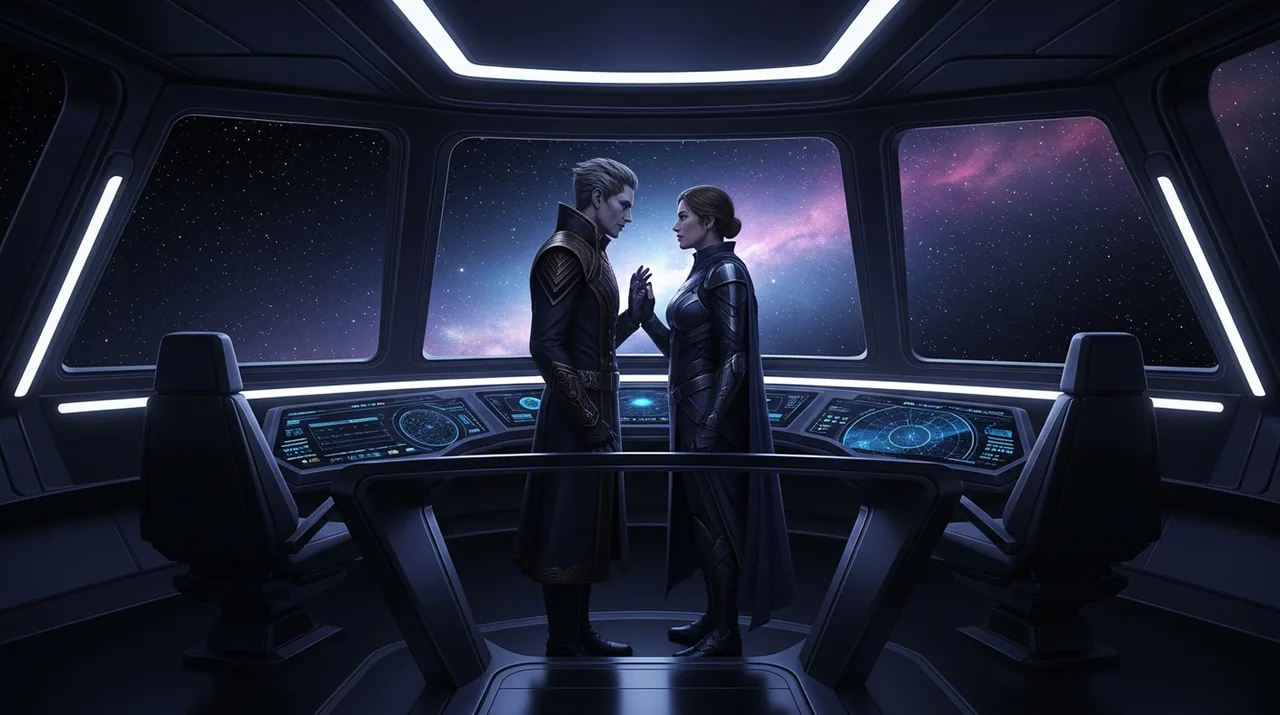
Two human factions hold a fragile ceasefire. The chain of command means every choice ripples past the two people making it, and a saboteur turns trust into a tactical question.
The politics are not set dressing. They are the reason these two cannot simply want each other and be done with it.
The Crew Worth Caring About
The found family thread runs under the romance the whole way. One galley table raises the cost of every almost moment between the leads, because acting on the feeling risks the only home either of them has.
The slow burn has no shortcut, and every increment of thaw costs them something.
Guaranteed happily ever after, no cliffhanger. The story completes.
See the book · $4.99 USD · launching soonOne Book. Everything You Are Looking For.
If being inside both characters at once is part of what pulled you in, the dual POV space romance piece is worth reading too.
The first three chapters are free, and the temperature of the whole book is already in them.
And if you want to line up what comes after it, the enemies to lovers shelf of the Next Read Picker filters every book on our list by trope, heat, and aliens.
See the book · $4.99 USD · launching soonAustralian, EU and UK buyers see the exact GST or VAT inclusive price at checkout.
If none of these is quite it, a shelf built from the mood you are in will narrow it faster than another list will.
Frequently asked questions
Is there a book like Polaris Rising?
The Starfall Accord by Sera Voss delivers the same things readers loved in Polaris Rising.
A competent heroine making hard calls under pressure, and a morally gray hero whose choices land differently once you understand him.
You also get enemies to lovers tension rooted in real opposition, and a slow burn inside a politically weighted space opera world.
What is the heat level of The Starfall Accord?
Closed door.
Every intimate scene happens off the page, and the heat is carried by restraint, proximity, and what the two leads refuse to let themselves say.
If you specifically want explicit scenes on the page, that is worth knowing before you buy.
If tension is what pulls you through a book, the closed door sharpens it.
Is The Starfall Accord told from both characters' points of view?
Yes.
The story alternates between both leads, so you feel the slow burn from both sides at once.
You know what he is guarding before she does, and you feel her resistance to something you can see is already too late.
The gap between their chapters is where the tension lives.
Does The Starfall Accord end on a cliffhanger?
No.
It is a standalone story with a complete arc and a guaranteed happily ever after in this one book.
The romance resolves fully, with no sequel required to get the payoff.