
Three chapters free, no email required
The Starfall Accord: Free Sample
She was sent to kill him.
He doesn't know.
The ship is small. The stars are watching.
Enemies to lovers · Dual point of view · Slow burn · Closed door · Human only, no aliens · Happily ever after guaranteed
~46 min read · Chapters 1 to 3 of 22 · 12,000 words free
The Starfall Accord is a closed door, dual POV, enemies to lovers space opera romance by Sera Voss.
This free sample is the first three chapters, about 12,000 words, which is a 46 minute read based on the 260 words per minute fiction average, with no email or account required.
The full novel continues for 22 chapters with a slow burn, found family aboard one warship, human characters only, and a guaranteed happily ever after with no cliffhanger.
The Starfall Accord is AI assisted fiction, edited line by line by a human author. Judge the prose yourself: the first three chapters are free.
Availability: the sample is free to read now, and the full ebook is launching soon, direct from the author.
Chapter 1: The Weapon She Carried Aboard
Kira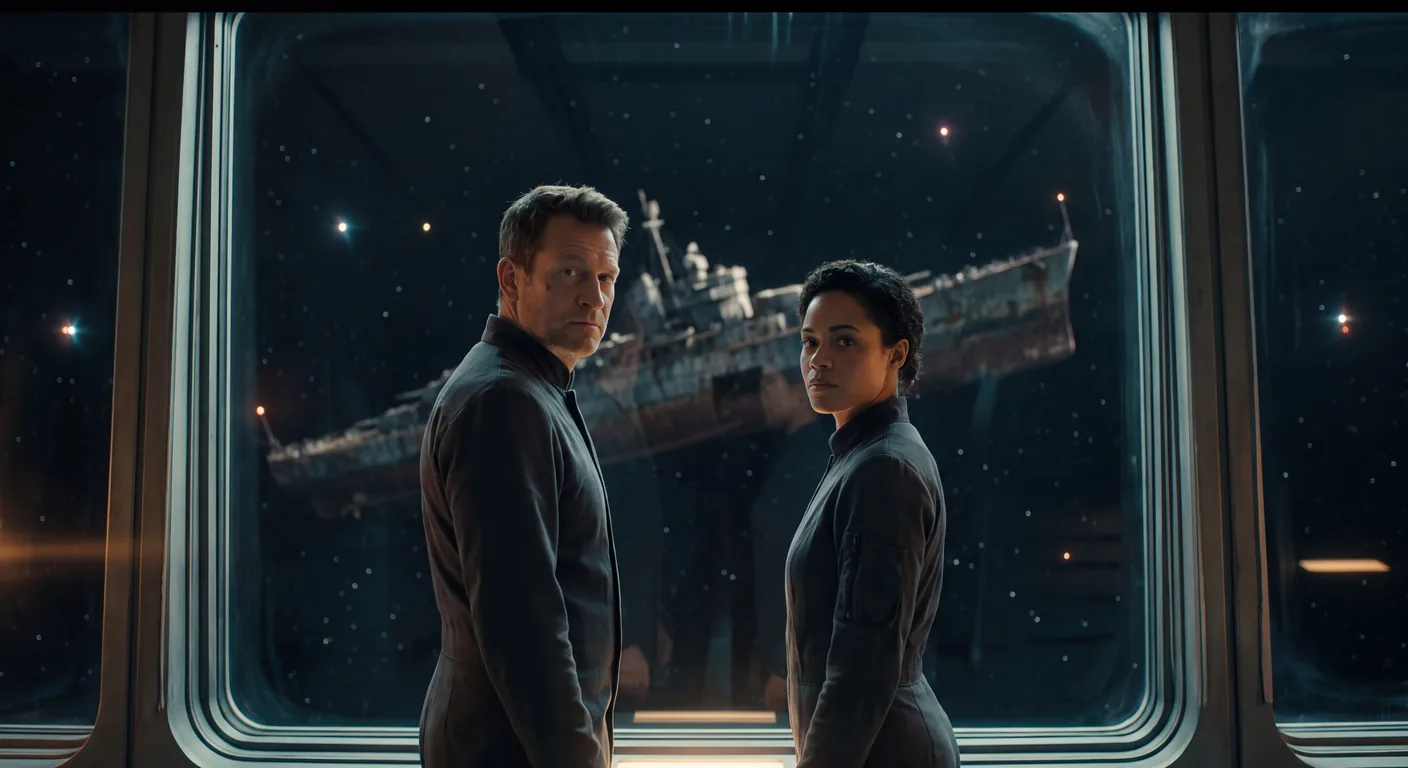
Kira checked her assassination orders one last time before docking.
The encryption key took four seconds to cycle. She counted them the way she counted everything: panels in the shuttle ceiling (fourteen), warning lights on the console (six, two amber), breaths since she'd dropped out of FTL transit (two hundred and eleven).
The orders loaded on her personal device in a font too small and too clean for what they described. Terminate Commander Thane Aldric if ceasefire negotiations are deemed to have failed. Authorization: Coalition Intelligence, Priority Black.
She closed the file. Wiped the screen. Tucked the device into her inner jacket pocket where it sat against her ribs like a second heartbeat.
The shuttle's recycled air tasted like copper and old filters. She'd been breathing it for eleven hours since the jump station, and her throat had gone dry in the first three. The water ration in the console cup holder was lukewarm, metallic, and she drank it anyway because dehydration made your hands shake, and her hands didn't shake.
Not anymore. Not since the first year after Kael-7, when she'd white knuckled her way through a medical evaluation and the flight surgeon had looked at the tremor in her fingers and said nothing and signed the clearance form anyway.
She set the empty cup back in its holder. The shuttle hummed around her, a low vibration she could feel through the soles of her boots and up through the base of her spine. Every ship had its own frequency. This shuttle ran at a pitch that sat right behind her teeth.
Fourteen Panels, Six Warnings
Through the viewport, the Meridian filled her entire field of vision.
A Dominion Vanguard class warship, three hundred meters of angular hull plating designed to absorb and redirect weapons fire. They'd stripped the torpedo arrays and sealed the forward gun ports with welded plates, but the bones of the thing were still military. You could paint a wolf, but you couldn't hide the teeth.
She gripped the flight stick and felt her knuckles lock white. The shuttle's instrument panel threw green light across her hands. Good hands. Steady hands. The hands of the best combat pilot the Coalition had produced during the war, according to the service record that Coalition Intelligence kept updating with commendations she'd never asked for.
Thirty seven sorties. Zero losses on her watch. Until the one that wasn't on her watch because she'd been two hundred and twelve kilometers away, running a recon sweep, hearing them die.
“Coalition shuttle Talon-7, you are cleared for Bay Three approach,” said a voice over comms. Male. Young. Too cheerful for a Dominion officer. “Magnetic clamps will engage on contact. Welcome aboard the Meridian, Lieutenant Vasic.”
“Copy,” she said. Not thank you. Not glad to be here. Copy. The minimum viable word.
She guided the shuttle through the approach corridor, fingers adjusting for the Meridian's gravitational pull. The ship's mass dragged at her controls like a hand closing around a throat. She could feel the Meridian's mag field through the flight stick, a pull that made the hairs on her forearms stand straight.
Twenty meters. Ten. The docking clamps engaged with a thud that resonated through the hull and into her molars. The shuttle's engines wound down from a whine to a groan to silence, and in that silence she heard her own breathing. Too fast. She slowed it. Four counts in, four out.
She was aboard an enemy ship.
Five years of ceasefire hadn't changed that math.
Ozone and Weapons Lubricant
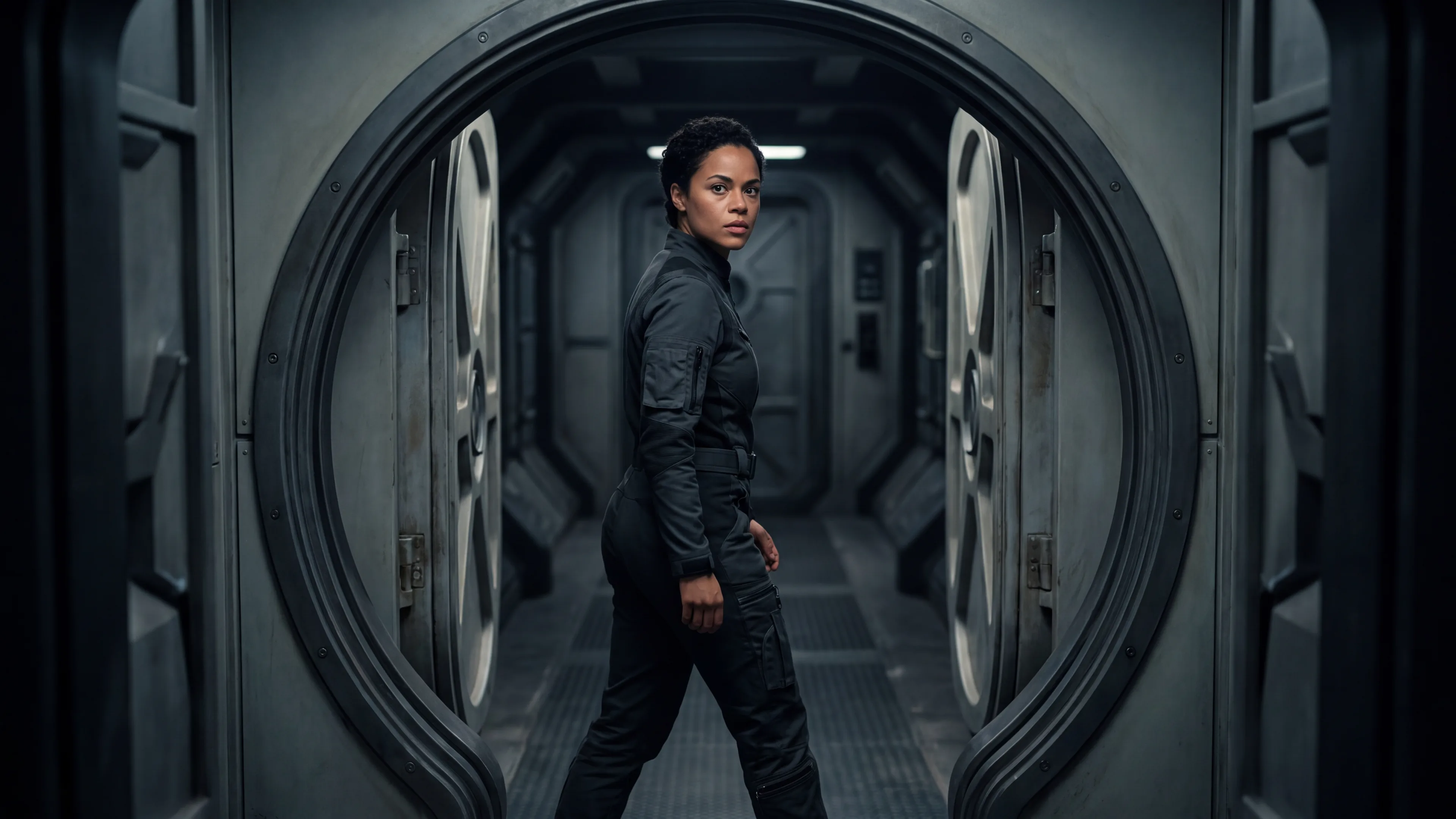
The inner door stands open. Kira steps onto a Dominion warship for the first time since the war.
The airlock cycled with a hiss of pressure equalization and the smell hit her first. Recycled air with an undertone of ozone and weapons lubricant. Dominion ships all smelled the same. She'd spent two years during the war memorizing that smell from the cockpits of captured vessels and the corridors of stations they'd taken and lost and taken again.
Coalition ships smelled different. Cleaner, sharper, with a chemical edge from the air scrubbers their engineers favored. You could identify a ship's faction with your eyes closed. Her body knew which smell meant safety and which meant danger, and the Meridian was triggering every alarm her limbic system had.
Kira stepped through the airlock and onto the Meridian's deck. The gravity was slightly heavier than the shuttle, a Dominion standard she recognized from intel briefings. They ran their ships at 1.03 standard, just enough to feel it in the shoulders after a long shift. A small discomfort she'd carry for the duration of this mission. One of many.
Her mag boots clicked against the grating. She counted the overhead panels without thinking about it. Twelve to the first junction. The corridor lights ran at sixty percent, casting everything in a flat, institutional wash that made the walls look like bone.
Sable Ortega, Chief Engineer
A woman waited at the junction. Stocky, maybe mid forties, with gray streaked black hair pulled into a bun held in place by what appeared to be a stylus. Engine grease darkened her knuckles and the creases of her palms. She wore no faction insignia. Just a tool belt and a look of professional disinterest.
“Sable Ortega. Chief engineer.” She didn't extend a hand. “Civilian contractor. I fix the ship. I don't care about your war.”
“Kira Vasic. Coalition liaison.”
“I know who you are.” Sable turned and started walking. “Bay Three puts you two decks below the bridge. I'll show you to your quarters. Try not to touch anything that looks important.”
Kira fell in step beside her. The corridor was narrow enough that their shoulders nearly touched, and the overhead lighting panels cast a flat white that made Sable's engine grease look like bruises on her knuckles.
A Working Warship's Archaeology
The deck plates had been cleaned recently but not well. Boot scuffs from a previous crew still marked the metal in patterns that told a story Kira could read: heavy traffic near the junctions, clustered footprints outside what would have been the combat information center, drag marks near the cargo lifts. A working warship's archaeology, preserved under a thin coat of peace.
The corridor branched ahead, and she mapped it automatically. Left toward engineering. Right toward what had once been the weapons control center, now marked with a handwritten sign that read Conference Room A. Someone had drawn a small flower beneath the text. Kira didn't know if that was optimism or mockery.
“How long have you been aboard?” Kira asked.
“Six weeks. Long enough to learn the plumbing and short enough to still be surprised by the politics.” Sable stopped at a sealed hatch and pressed her palm to the reader. “Your quarters. It's small. It used to be a weapons locker.”
“Fitting.”
Word of Advice, Lieutenant
Sable looked at her for the first time with something beyond professional detachment. A flicker of assessment, maybe. Or pity. “Word of advice, Lieutenant. You don't build peace by holding onto what the war took from you. You build it by letting go of the weapon.”
Kira held the engineer's gaze. The device in her jacket pocket pressed against her ribs. “I'll keep that in mind.”
“You won't.” Sable shrugged. “But I said it, so my conscience is clean. Briefing's in forty minutes, Conference Room A. Don't be late. The Dominion commander runs on schedule like his blood's made of clock parts.”
Former Weapons Locker
She walked away. Kira stood in the doorway of her quarters (former weapons locker, two meters by three, a fold down bunk, a storage unit, a mirror she'd cover before the day was out) and counted the rivets in the ceiling. Twenty seven.
The room smelled like industrial solvent and the ghost of whatever propellant they'd stored here before the conversion. She set her kit bag on the bunk and ran her hand along the wall. Cold alloy, faintly textured under her fingertips. Dominion manufacturing. She could tell by the seam welds, tighter and more uniform than Coalition standard. Precise people built precise things.
She checked the environmental controls. Standard atmo, 21% oxygen, humidity at 40%, which explained the dryness in her throat. The deck plates vibrated with a subsonic hum from the ship's core reactor two decks below. She could feel it through her mag boots, a constant heartbeat that wasn't hers.
The mirror above the storage unit caught her reflection. Dark eyes, the line of her jaw slightly off center where it had healed wrong. She unzipped her jacket and hung it on the bunk frame. The device shifted against her ribs. She left the jacket close enough to reach.
She had forty minutes. Enough time to stow her gear, check the exits from this section (three), and review Thane Aldric's service record one more time. She already knew it by heart. Every commendation, every battle, every command decision. Including Kael-7.
Especially Kael-7.
Three Chairs Each Side
Conference Room A still had the mounting brackets where a tactical display had once projected fleet movements and kill zones. Now a portable holo table occupied the center, displaying a map of the Neutral Transit Corridor connecting Coalition and Dominion space. Six chairs ringed the table. Three on each side.
Kira arrived four minutes early and took the chair closest to the door. Habit. The room had two exits: the main hatch and a service panel behind the far bulkhead that she'd identified on the walk over. She sat with her back to neither.
The young Dominion officer who'd welcomed her over comms was already there. Tall, lanky, with brown skin and bright eyes and a uniform that looked like he'd slept in it. He grinned when she entered, which wasn't the standard Dominion response to Coalition personnel.
“Lieutenant Vasic. Dex Maro, communications specialist.” He waved from across the table. “I do the talking to-people stuff. Which, on this mission, basically makes me a professional hostage negotiator.”
“You always this friendly with the other side?”
“Only when they look like they could kill me with a stylus. I find preemptive charm buys survival time.” He leaned back in his chair. “Also, I genuinely don't care about factions. I care about signal arrays and whether the food dispenser makes decent coffee. It does not, by the way. Fair warning.”
A woman entered behind Kira. Tall, angular, dark skin, close cropped hair with a silver streak. Coalition uniform, pressed sharp enough to cut. She looked at Kira, then at Dex, then at the seating arrangement.
“Lieutenant Vasic.” She took the chair beside Kira. “Lieutenant Maren Solari. Navigation.”
“I know your record,” Kira said. “Ran the Valen Strait blockade twice.”
“Three times. The third did not make the official reports.” Maren's posture was rigid. Her eyes moved across the room with the same mapping reflex Kira recognized in herself. Another veteran.
A sandy haired man slipped in next, carrying a med kit over one shoulder. He nodded to Dex, took a seat on the Dominion side, and set the kit on the floor beside his chair. His hands were calloused but his movements were gentle, precise. A healer's economy.
“Joss Kade,” Dex said. “Ship's medic. Don't let the quiet fool you. He's diagnosed three people this week who didn't know they were sick.”
“Two,” Joss said. “Dex, you were not sick. You had a hangover.”
“Medically significant discomfort.”
The room had sorted itself without anyone saying a word. Coalition on one side. Dominion on the other. Sable arrived last, took a chair at the head of the table that belonged to neither side, and began cleaning grease from under her nails with the stylus from her hair.
Kira's hands were flat on the table. She could feel her pulse in her fingertips. Six people in the room. Two exits. One objective: assess the situation, assess the enemy, report back.
The door opened.
Thane Aldric walked in.
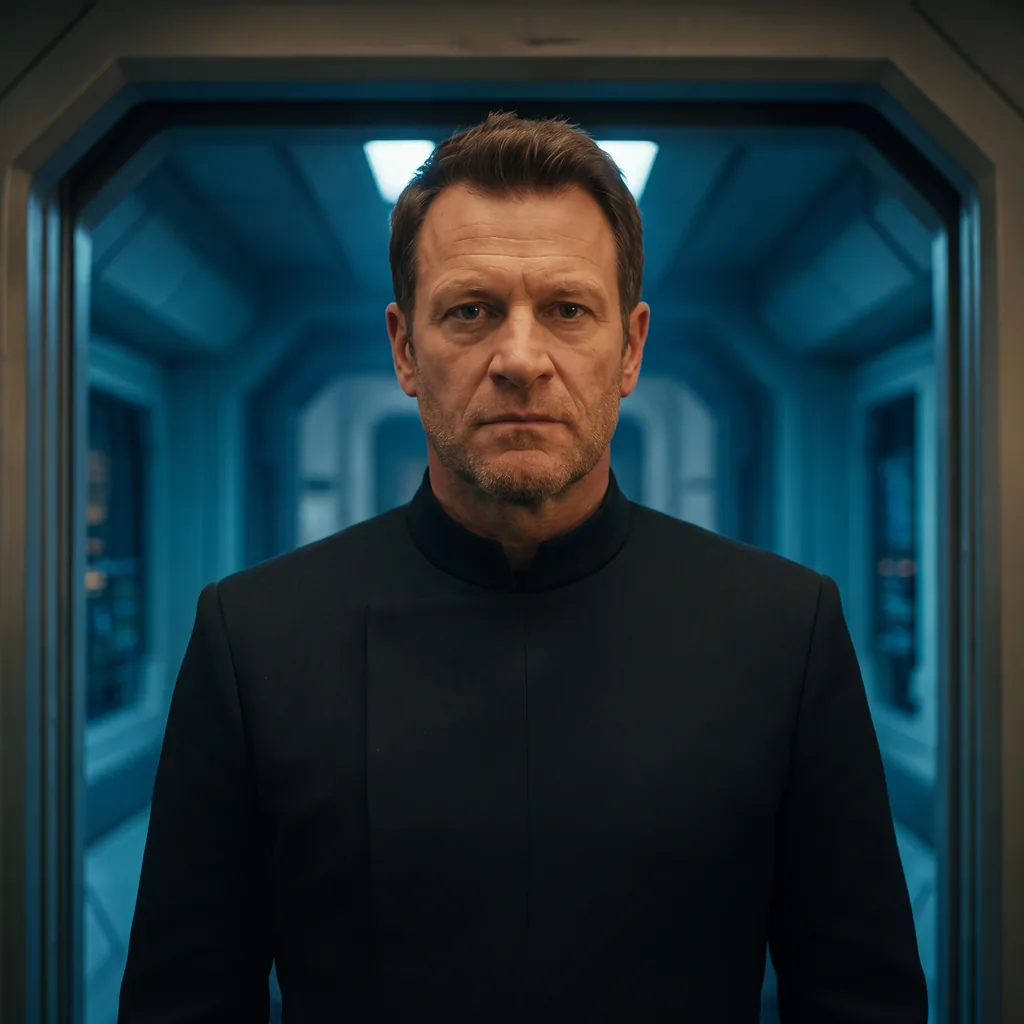
Thane Aldric in the doorway, lit from behind by the corridor he came down.
The Man, Not the Monster
He filled the doorway the way the Meridian filled a viewport. Not loudly. Not with any performance of size. Just present, in a way that rearranged the gravity of the room.
Broad shoulders, dark blond hair going shaggy at the temples where the regulation cut was growing out. Charcoal uniform, clean lines, rank insignia stripped off. The absence of those markers said more than their presence would have.
Kira cataloged him the way she cataloged every potential threat: center mass, limb reach, weight distribution, signs of concealed weaponry. Military habit. But something else cut through the assessment, something the tactical part of her brain hadn't authorized.
He moved with a control that looked rehearsed, or inherited, like someone who'd learned stillness the hard way. Every gesture calibrated, every shift of weight intentional. The pilot in her recognized it. Control like that came from training so deep it had rewritten the nervous system. You didn't move like that unless you'd spent years in environments where an uncontrolled movement could kill you.
He was dangerous. That registered first.
Then, underneath the danger assessment, something she refused to examine: the way the charcoal uniform sat across his shoulders. The line of his collarbone at the base of his throat. The fact that when he stepped into the room, she became aware of the distance between her chair and his body in a way that had nothing to do with tactical positioning.
She shoved that thought down and kept it there.
Gray eyes swept the room. Not scanning for threats the way Kira's did. Cataloging. Evaluating. Landing on each person like he was reading a report and filing it somewhere precise.
He carried a data pad in his left hand. Kira noticed the hand. Long fingers. The edge of a scar visible below his sleeve, running across the back of his wrist. He held the pad carefully, the way you hold something when the alternative is holding nothing and your hands don't know what to do with emptiness.
Formerly of the Third Fleet
“Thank you for your punctuality,” he said. Complete sentences. Measured cadence. A voice built for command that was trying to learn the register of diplomacy. “I'm Commander Thane Aldric, formerly of the Dominion Third Fleet. I serve as diplomatic liaison for this mission.”
Formerly. He said it without flinching. Kira watched his jaw. No tension. He'd practiced that word. She wondered how many times.
In his quarters, maybe, in front of a mirror he probably didn't cover. Saying formerly until it stopped tasting like failure. She recognized the discipline because she had her own version of it. Breathing exercises at 0300 when the nightmares hit. Counting panels until the numbers drowned out the silence on the comms.
“The Meridian has been repurposed as a neutral courier vessel tasked with transporting diplomatic materials between Coalition and Dominion negotiating teams along the Transit Corridor. Our crew is drawn from both factions. Our mission is straightforward: maintain the ship, run the route, prove that cooperation is possible.”
He set the data pad on the table. His eyes found Kira's.
What She Expected to Feel
She was ready for it. She'd spent five years preparing for this moment, rehearsing it in the dark of her quarters on a dozen stations and ships, imagining what she'd feel when she looked at the man who'd ordered the deaths of forty three people she'd loved.
She expected rage. She expected the white hot clarity of hatred that had kept her alive for five years.
What she got was worse.
He looked tired. There were lines around his gray eyes that hadn't been in his service photo. His posture was perfect but the perfection had a brittleness to it, like a wall maintained through force of will rather than conviction.
He wasn't a monster. He wasn't the cold eyed butcher she'd constructed in her mind over five years of nightmares and mission debriefs and bottles emptied alone.
He was a man. Flesh and bone and fatigue and a scar on his hand she hadn't known about. A man who said “formerly” about himself without blinking.
That was worse. Monsters were simple. Men were complicated. Men had reasons. Men could be understood. And understanding was the first crack in the wall she needed to survive.
“Lieutenant Vasic.” His voice was careful. Neutral. “Welcome aboard.”
“Commander.” She didn't return the welcome. She didn't need to.
Six People, Two Factions, One Ship
The briefing proceeded. Aldric outlined the courier schedule, the transit corridor waypoints, the communication protocols. Voss would join them at Waypoint Four as Dominion oversight. Faction channels would remain separate but shared emergency frequencies were now active. The Meridian operated on standard Dominion ship time. Meals were communal. Quarters were assigned by deck, not faction.
She watched the crew while he spoke. Dex took notes on a personal device propped against his coffee thermos, his long fingers moving with the speed of someone who typed the way other people breathed.
Joss listened without writing, absorbing information through observation rather than notation, his hands resting on the med kit beside his chair. Maren's back was a straight line. Her data pad displayed a pre loaded copy of the courier route, already annotated with her own navigational calculations.
Sable had stopped cleaning her nails and was watching Aldric with the appraising eye of someone judging not what a person said but how they said it.
Kira listened to his voice more than his words. The cadence was military briefing standard, but there were pauses where a career officer wouldn't pause. Before personal pronouns. Before the word cooperation. Before anything that required him to claim an outcome rather than deliver a fact. He was more comfortable with data than with aspiration. That told her something about him that his service record didn't.
Six people. Two factions. One ship. The mathematics of forced proximity.
Kira absorbed all of it while watching Aldric's left hand. He kept it below the table when he wasn't holding the data pad. The scars extended further than the sleeve revealed. Burns, she thought. Plasma console burns. She'd seen them on Coalition survivors pulled from wreckage.
He'd been at Kael-7 too. Not just as a commander giving orders from a safe distance. He'd been close enough to burn.
That fact lodged in her chest like shrapnel she couldn't remove.
Twenty Seven Rivets and a Ghost
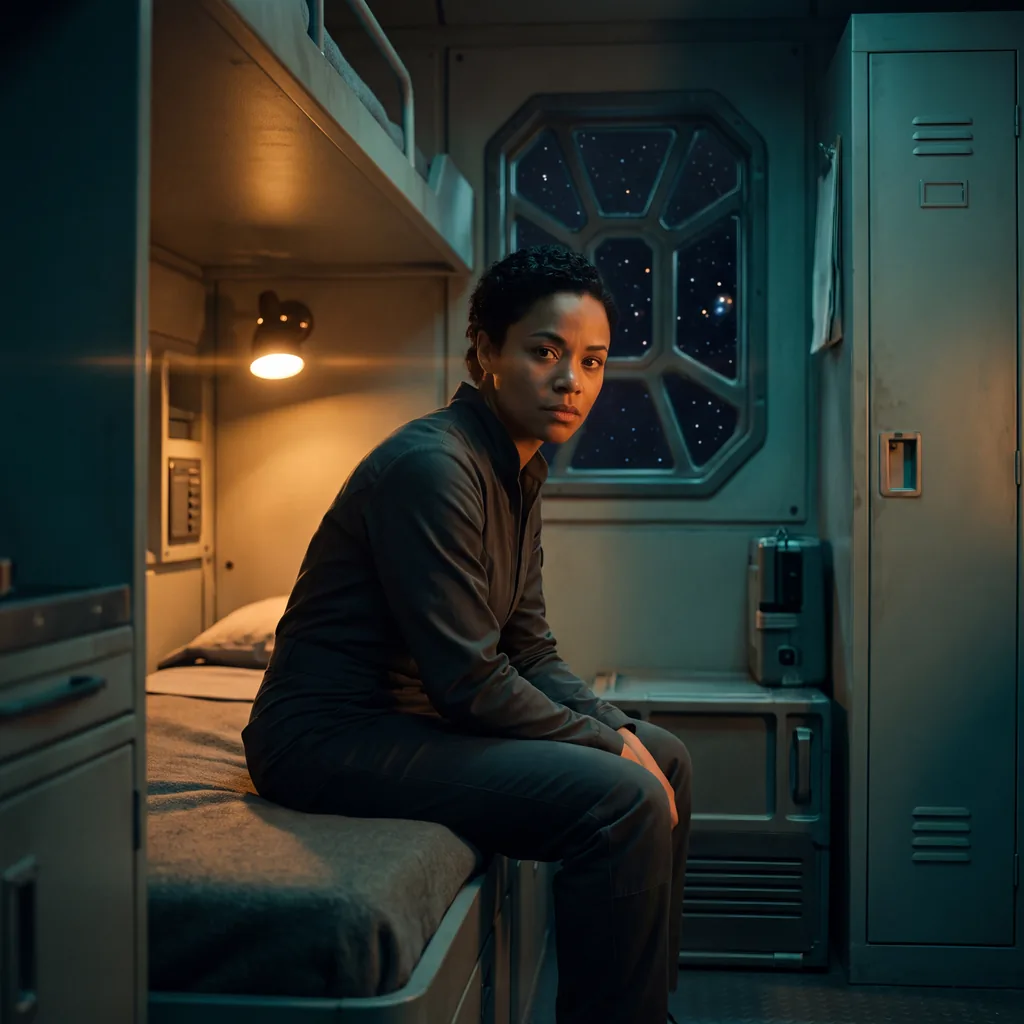
Kira alone in her quarters with the hatch sealed, and one small window that is not made of metal.
Kira returned to her quarters and sealed the hatch behind her.
Twenty seven rivets. She counted them again to make sure. The number hadn't changed in forty minutes, which was irrational to verify and impossible not to. The quarters were exactly as small as they'd been before the briefing, but now they felt smaller, because now she'd seen him.
She pulled the device from her jacket and opened the orders again. The encryption cycled. Four seconds. The words loaded.
Terminate Commander Thane Aldric if ceasefire negotiations are deemed to have failed.
She read the sentence three times. The first time, it was an order. The second time, it was a question.
The third time, it was the sound of Bishop's voice cutting through static on the comms at Kael-7. “Talon Lead, we've got incoming, bearing two seven-zero, it's the whole damn” and then silence. Not the silence of a transmission ending. The silence of a voice being subtracted from the universe.
Then another silence, and another, until forty three voices became zero in the space of ninety seconds while she hung in the dark two hundred klicks out, listening, unable to move, unable to breathe, counting the absences.
She closed the file. Her hand was steady. Her jaw was not. She pressed her back against the wall and held herself there until the muscle in her jaw released. Four breaths. Five.
Thane Aldric had scars on his hand from Kael-7. He'd been close enough to burn while her people died. She didn't know what to do with that information. It sat wrong inside her chest, like a bone that had healed at the wrong angle and now ached when the pressure changed.
She stood. Checked the time. Straightened her jacket. The device went back against her ribs.
There was a ship to map.
Forty Six Steps to the Bridge
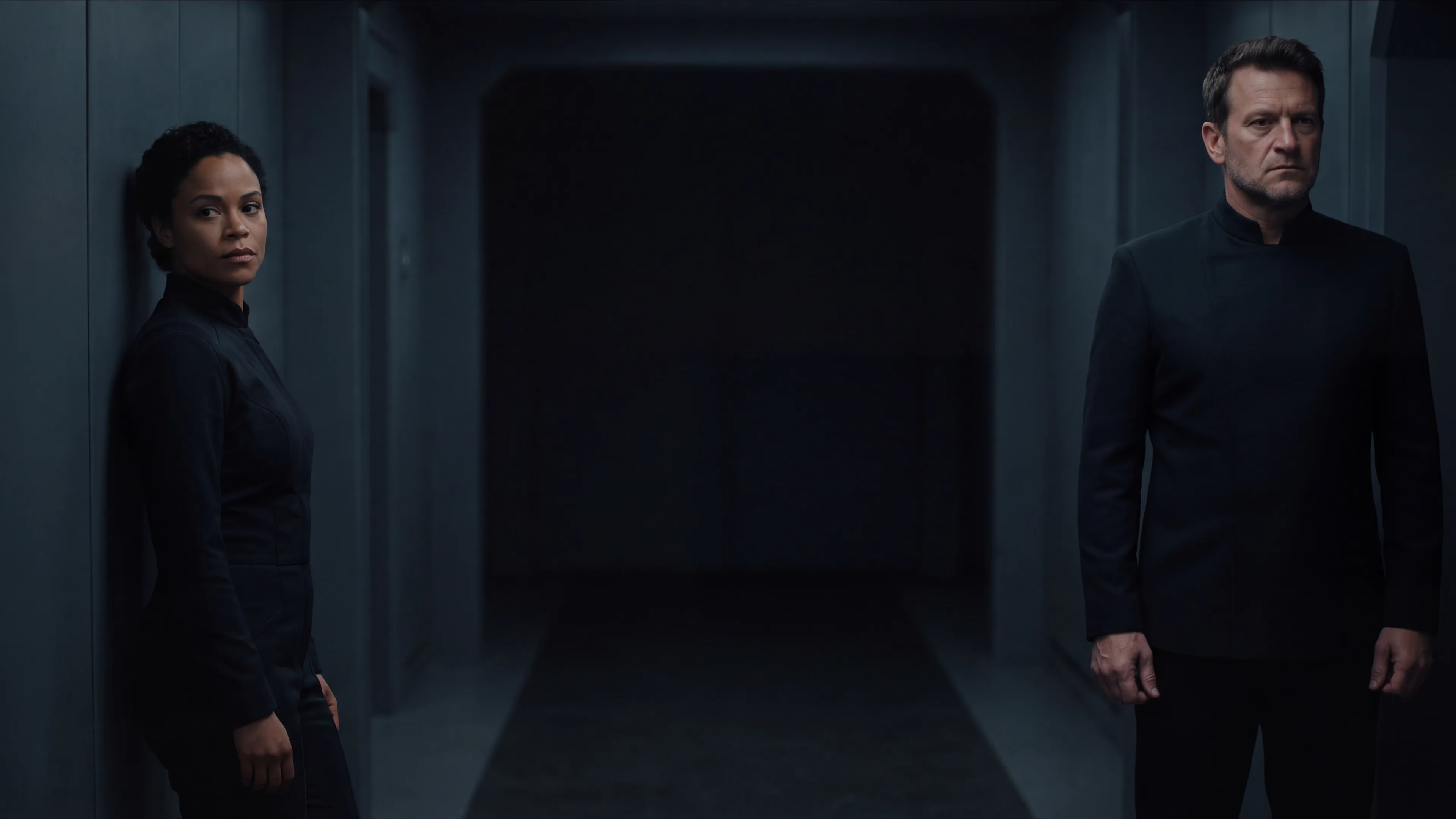
Kira and Thane at opposite ends of the main corridor, the whole length of the deck between them.
After the briefing, Kira walked the ship.
Not to explore. To map. She paced the corridors with the same attention she'd give a flight grid before a combat sortie. The deck plating hummed through her boot soles, a different pitch on each deck. Deck One ran high and tight, a whine she felt in her teeth. Deck Two was lower, almost soothing. Deck Three was where the reactor lived, and the vibration there was deep enough to settle in her sternum.
Main corridor: forty six steps from her quarters to the bridge. Secondary corridor: thirty one to engineering. Emergency escape pods: eight, distributed across three decks, each capable of holding four.
The mess hall sat amidships, a converted crew lounge with a food dispenser built into the far wall and a long table that could seat twelve but had six chairs arranged at one end. Someone had left a coffee thermos on the table. Dex's, probably.
The ship had been designed for a crew of sixty. There were six of them aboard. The empty spaces rang with every footstep.
Kira passed sealed hatches with designations she didn't recognize, crew quarters that would never house crew, a fitness bay with equipment bolted to the floor that nobody used. The Meridian was a ship built for war carrying six people who were supposed to be building peace. The math didn't add up. But then, nothing about this mission did.
The Observation Port on Deck Two
She stopped at an observation port on Deck Two. The glass was cold against her fingertips when she touched the frame.
Through the reinforced composite, the Transit Corridor stretched ahead, a ribbon of navigational beacons marking the ceasefire boundary between Coalition and Dominion space. The lights pulsed in sequence, red and blue, red and blue, a heartbeat between two bodies that had spent a decade trying to kill each other.
The corridor was quiet at this hour. The Meridian's environmental systems cycled through their evening protocol, dropping the lighting another ten percent, adjusting the air temperature downward by two degrees.
The ship was preparing for night, and for a moment, standing alone in the dimming light with the stars beyond the glass, Kira felt the scale of where she was. A small woman on a large ship in an ocean of nothing, carrying orders to kill a man who looked tired.
The Words Branded Into Memory
Her hand went to the device in her jacket. She didn't open the file. Didn't need to. The words were branded into her memory.
Terminate Commander Thane Aldric if ceasefire negotiations are deemed to have failed.
She pressed her palm flat against the observation port. The glass was cold. It radiated the deep chill of space through the triple layered composite, enough to numb her fingertips in thirty seconds. She kept her hand there. The cold was honest. It didn't pretend to be anything but what it was.
Beyond the glass, the vacuum. Beyond the vacuum, the stars she'd navigated by for fifteen years. Some of them were the last things her squadron had seen.
Bishop's Cross
She could name the constellations from this position. Pilot's reflex. The Anvil. The Corridor. The cluster they'd called Bishop's Cross after her wingman, because he'd used it as a navigation anchor during the Valen operations, and after he died the name had stuck because that was how you kept the dead alive.
You named things after them. You carried their callsigns in your chest like fragments of a language only the survivors spoke.
She closed her eyes. Counted heartbeats. One. Two. Three.
His Reflection in the Glass
Footsteps in the corridor behind her. She opened her eyes and saw Aldric's reflection in the glass. He'd stopped six meters away. Keeping his distance. His hands were clasped behind his back, and in the dim corridor lighting, the burn scars on his left hand were visible for the first time. A lattice of silver white tissue that crawled from his knuckles past his wrist and disappeared under the sleeve.
He didn't speak. He looked at the stars with the same expression she imagined was on her own face. Like he was searching for something that wasn't there anymore.
Then he turned and walked away. Six meters of distance, maintained. She listened to his footsteps recede. Precise. Even. The walk of a man who measured everything, including the space between himself and other people.
Kira turned back to the viewport. Her reflection stared at her from the glass. Dark eyes, jaw length dark hair, the thin scar on her forearm from Kael-7 shrapnel. She looked exactly like the woman Coalition Intelligence had sent to assess whether a man needed killing.
A Mirror, Not a Monster
The problem was Thane Aldric.
He wasn't the monster she'd imagined. He was a man carrying his own scars from the same battle that had broken her. And a man with scars was harder to kill than a monster with none.
That made everything more dangerous. Not less. Because a monster you could hate without complication. A man who carried his damage the way she carried hers, visible in the scars and the posture and the careful distance he maintained from everyone around him, a man like that was not a monster. A man like that was a mirror. And mirrors were harder to destroy than enemies.
She pressed her palm against the viewport glass. Cold. The vacuum beyond it was absolute, the kind of cold that killed without malice, without intent, simply by being what it was.
And somewhere in it, a man she'd been sent to kill was walking the corridors of this ship with burn scars on his hand and guilt in his posture and a voice that sounded, when he wasn't performing command, like someone who'd forgotten how to ask for help.
Forty three, she thought. Forty three. Forty three.
She counted until the number was just a number again. Then she turned from the viewport and went to sleep.

Beyond the glass, the stars she had navigated by for eleven years.
She called him a mirror. Harder to destroy than an enemy.
Chapter 2 shifts to his POV.
You're about to see what he carries at 0500, alone on the bridge, when no one is watching.
Or keep reading Chapter 2 below
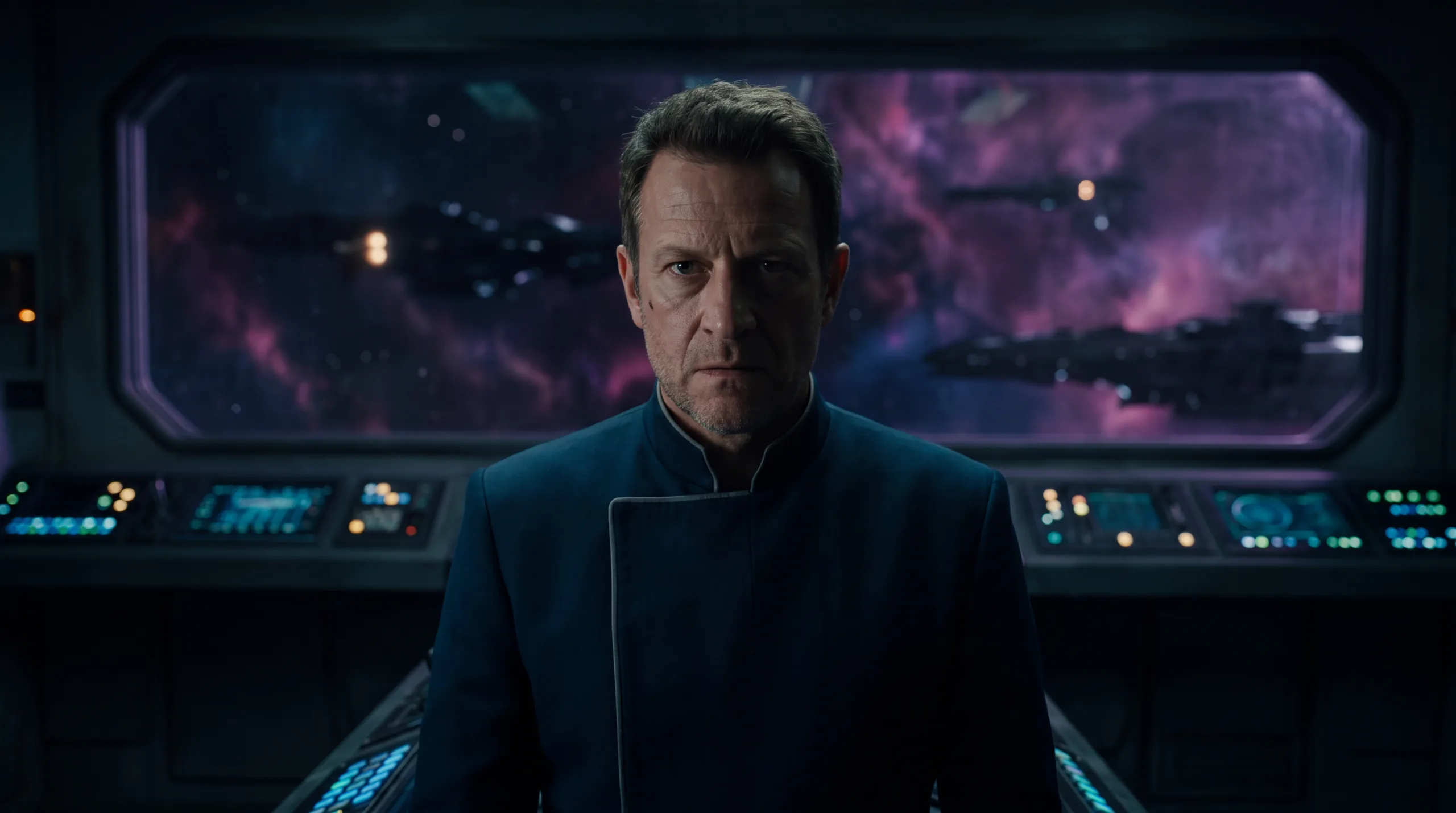
Thane Aldric on the bridge at 0500, two hours before anyone else is awake.
Chapter 2: The Commander Without a Command
Thane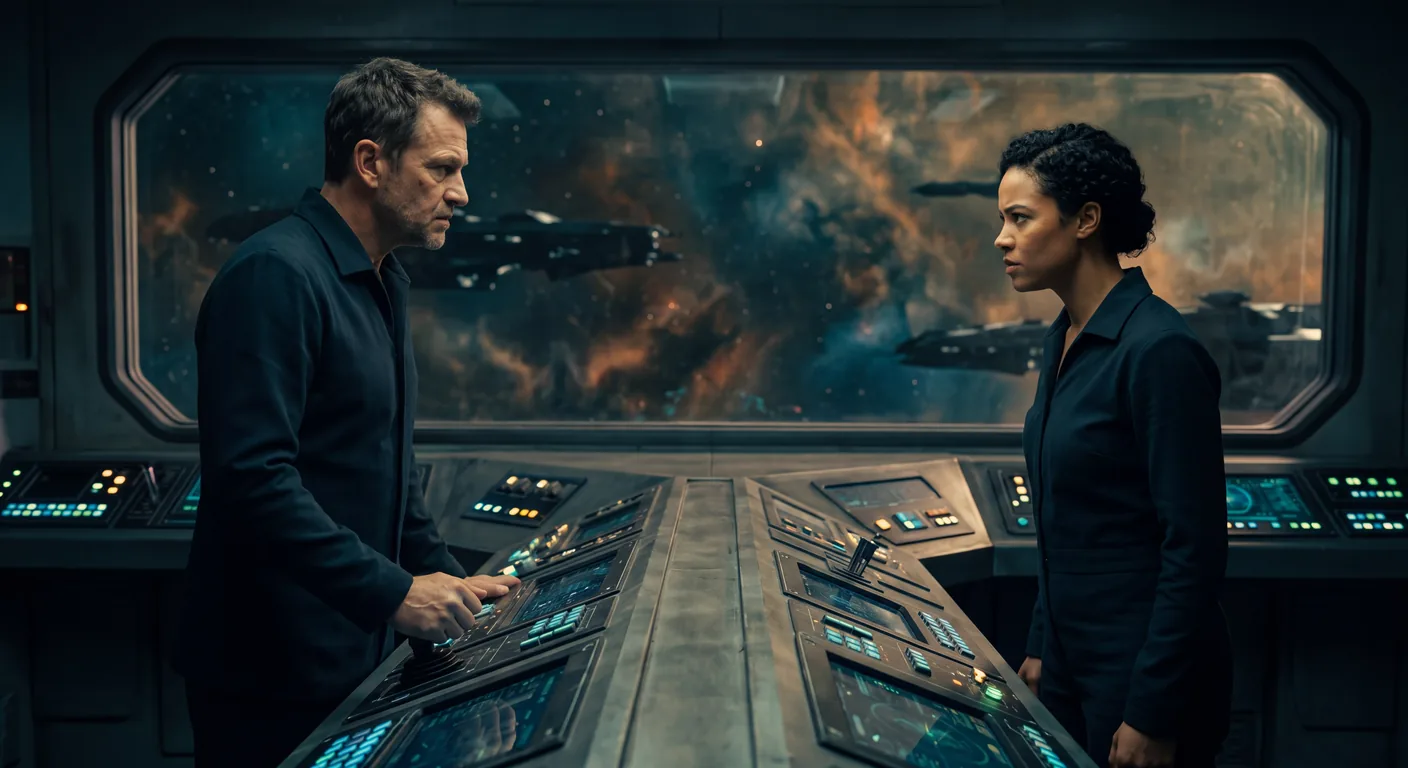
They'd stripped his warship of its teeth and handed him a clipboard.
Thane Aldric stood on the bridge of the Meridian at 0500 ship time, two hours before the rest of the crew would wake, and watched the navigational displays cycle through their diagnostic routines.
The bridge had been designed for a command team of twelve. Tactical stations ringed the central platform, each one dark and powered down. The weapons console had been physically disconnected, its cables severed and capped with bright yellow safety tags. Someone had placed a potted fern on the targeting array.
He rested his hands on the command railing. The metal was cool against the scar tissue on his left hand. He'd learned not to notice the tightness in the skin, the way the burn scars pulled when the air was dry or when he gripped something too hard. Five years was long enough to stop noticing most things.
Not everything. Not the quiet. Not the absence of voices that used to fill this bridge.
Tactical Officer Rehn, who called out targeting solutions in a voice like a metronome. Navigation Specialist Cho, who hummed under her breath during FTL calculations. The ops team running status boards, comms officers relaying fleet orders, the weapons crew counting torpedo loads.
Fifty eight people who had trusted his judgment, and in return he had brought them through nine engagements and one war ending strike without losing a single member of his crew.
His crew had survived Kael-7. The bridge crew of the Dominion's Grace, the warship he'd commanded during the engagement, had survived because they were shielded behind armored bulkheads while the weapons they'd fired traveled across space and ended lives at the other end of the targeting solution.
They'd survived, and some of them still served, and none of them talked about Kael-7 in his presence because his silence on the subject was its own standing order.
Kira Vasic's had not. The asymmetry of that outcome followed him through every room of this ship.
The Meridian had been his ship. His command.
Built at the Vespera shipyard seventeen years ago as a Vanguard class assault platform, commissioned into the Dominion Third Fleet under Captain Halleck, transferred to Thane's command four years into the war when Halleck retired with shrapnel in his spine. He'd run a crew of fifty eight from this bridge through nine engagements and the final assault that broke the Coalition's defensive line at Kael-7.
Every bulkhead on this ship had a history he carried in his bones.
The port corridor on Deck Two, where a hull breach during the Veritas Station engagement had killed two crewmen and he'd sealed the compartment himself, listening to the atmosphere vent through the breach with a sound like a scream cut short.
The engine room, where Sable worked now without knowing that the same deck plating had buckled under a torpedo impact and trapped an engineering team for six hours.
The mess hall, where he'd addressed his crew before Kael-7, standing at the head of the table, and told them the war would end in the next twenty four hours, one way or another.
The bridge had been loud then. Status reports, targeting solutions, the steady rhythm of a warship functioning at combat peak. Now the only sound was the environmental system cycling air through vents that had once carried the smell of cordite and burning insulation.
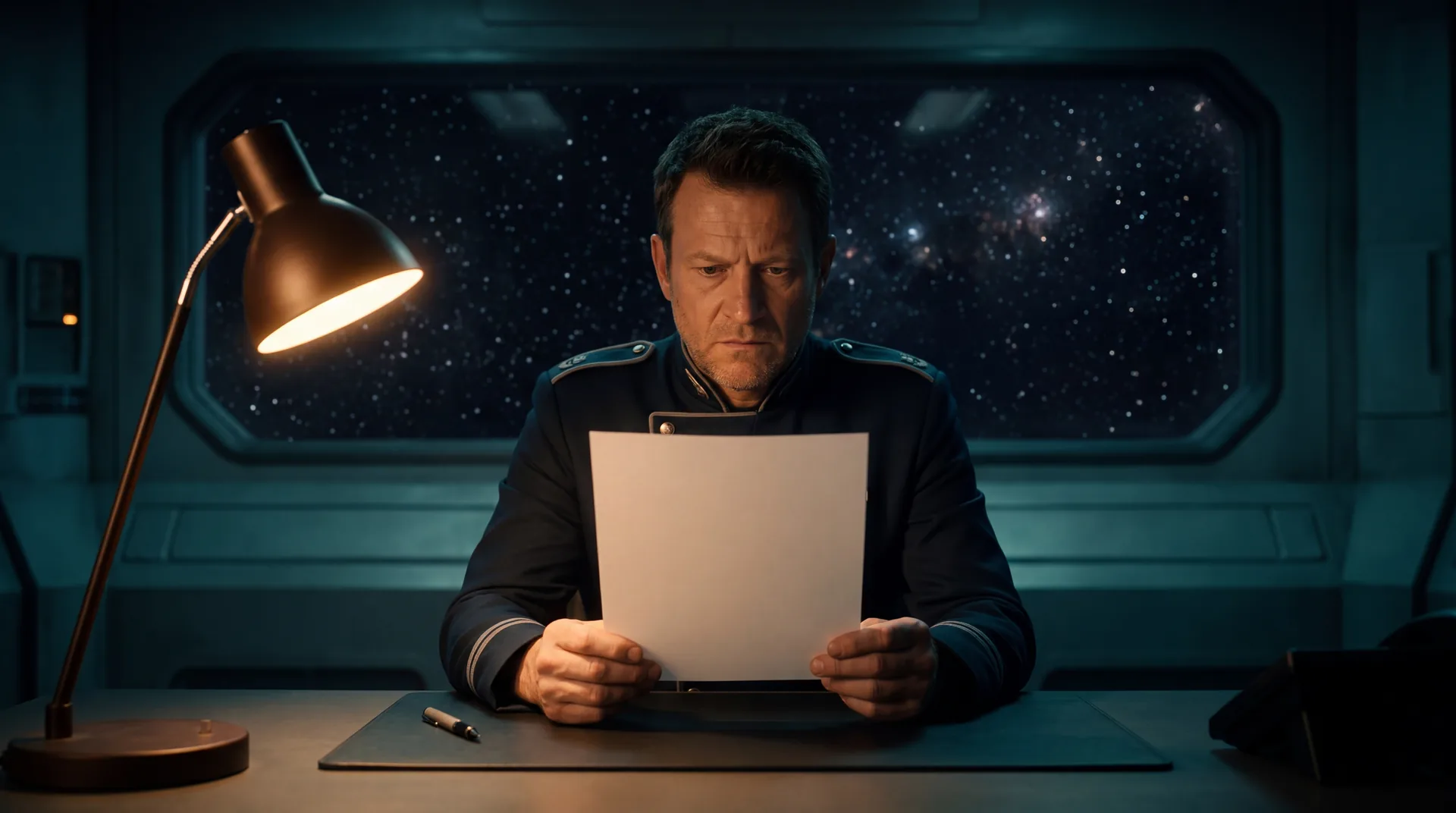
Alone with the day's courier schedule. The work of a postal service in military clothing.
A Fern on the Targeting Array
He pulled up the courier schedule on the main display. Transit Corridor waypoints, diplomatic packet delivery windows, communication check in protocols. The work of a postal service dressed in military clothing.
It was necessary work. He believed that. He had to believe it, because the alternative was admitting that the Dominion had won the war and then thrown away the victory by promoting their most capable tactical officer to glorified mail carrier.
He heard the airlock cycling three decks below. The vibration traveled through the hull, familiar as a pulse.
The Coalition shuttle had docked nine hours ago, delivering Lieutenant Kira Vasic and Lieutenant Maren Solari to his ship. To his corridor. To the briefing room where he'd sat across a table from a woman whose squadron he'd killed and pretended that professional neutrality was the same thing as composure.
Vasic.
He'd reviewed her complete service file after the briefing. Not the summary version Coalition Intelligence had shared through diplomatic channels. The full record, the one Dominion Intelligence had compiled from intercepted reports and engagement data during the war.
Thirty seven sorties. Zero losses under her direct command. She'd flown escort, interdiction, and deep reconnaissance missions across four sectors. Her flight instructor had written a single note in the margin of her qualification report: Natural. Don't teach the reflexes out of her.
He'd closed the file and sat in his quarters thinking about the word natural.
Then he'd opened the Kael-7 engagement data again and found her callsign in the sensor logs. Talon Lead, positioned 212 kilometers from the engagement zone at the moment of the strike. Her recon vector had taken her away from the battle.
Ninety seconds of comms traffic between her and her squadron, then silence. She had been close enough to hear and too far to act.
He understood, with a precision that felt like a wound, that she had lived because his tactical analysis had not included her vector as a threat. He had killed forty three people and spared one, not by choice, but by oversight. She survived because he hadn't noticed her.
She'd watched him through the entire briefing with eyes that didn't blink often enough. Dark brown, almost black. The kind of eyes that made you feel cataloged.
She'd sat with her back to neither exit and her hands flat on the table, and he'd recognized the posture because it was a combat posture. She was mapping the room. Counting threats. Running calculations about proximity and distance and the speed at which a situation could turn lethal.
He knew because he'd done the same thing.
Thirty Meters of Empty Space
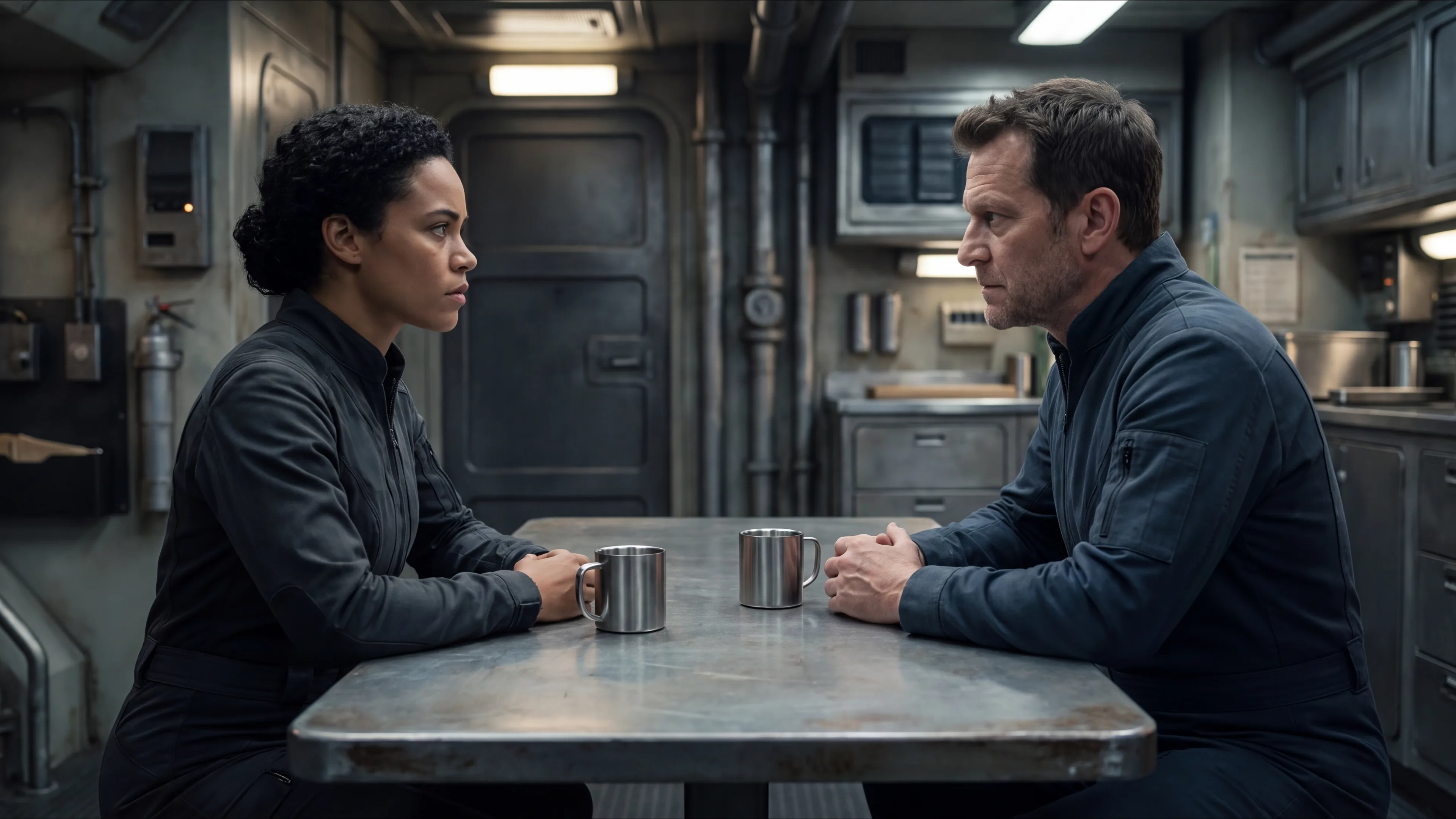
The Meridian's mess hall. Two mugs on a steel table, and neither of them touching theirs.
Breakfast on the Meridian was communal by design and segregated by habit. The mess hall was a converted crew lounge, tables bolted to the floor in rows of three. When Thane arrived at 0700, Dex and Joss occupied one end of the nearest table. The Coalition personnel occupied the far corner. Two factions, six people, thirty meters of empty space between them.
He collected his tray from the dispenser. Standard Dominion field rations, reheated: protein block, grain supplement, reconstituted fruit. The food was adequate and joyless, which he found appropriate.
“Morning, sir.” Dex looked up from a comm relay schematic he'd spread across the table between his coffee and his ration tray. “Sleep well?”
“Adequately.”
“That's a no,” Dex said to Joss. “He slept adequately, which is Aldric for ‘I stared at the ceiling running battle simulations in my head until the alarm went off.’”
“Dex.” One word, level. Enough.
“Right. Boundaries. Noted.” Dex returned to his schematic. “The port side comm array has a signal degradation issue. Probably a coupling in the junction box. I'll fix it after breakfast.”
Thane sat across from them. Not beside. The table had room for eight. He chose the seat that maintained a meter of clearance on either side. This wasn't something he thought about consciously. It was the geometry of a man who had spent four years in command, where proximity meant vulnerability and distance meant control.
Joss watched him eat. Joss always watched him eat. The medic had a habit of monitoring the crew's intake, hydration, and posture with the quiet attentiveness of a man who'd spent the war pulling soldiers out of wreckage and wanted to catch the damage before it required extraction.
“Commander,” Joss said. “Medical check in at 0900. Standard post assignment baseline.”
“I'll be there.”
“Both hands, this time. Not just the right.”
Thane stopped chewing. He placed his left hand flat on the table, palm down. The scars were visible in the mess hall lighting, a topographic map of a console explosion that had thrown him four meters across the bridge during the final minutes of Kael-7. He'd given the firing order, and then the bridge had exploded around him, and when he woke in the medical bay, the war was over and his hand looked like melted candle wax.
“Both hands,” he said.
Joss nodded and returned to his food.
Movement at the far end of the mess. Thane's eyes tracked it without turning his head. Vasic and Solari, collecting their trays from the dispenser. Solari sat at their corner table with military precision. Vasic hesitated. Her gaze swept the room, found Thane, and held longer than it should have before she sat down.
He went back to his protein block.
“She's intense,” Dex said, not bothering to lower his voice.
“Dex.”
“What? I'm making an observation. Professionally. As comms officer. She communicates intensity. I'm reading the signal.”
Thane did not respond.
Observer, Not Neutral
The morning briefing was scheduled for 0800 in Conference Room A. Thane arrived at 0755. Vasic was already there, in the same chair, closest to the door. She'd changed into a clean flight jacket, worn at the elbows and patched at the left shoulder. Coalition standard issue, but old. Pre ceasefire old. She wore it like armor.
Maren sat beside her, rigid and correct. Dex slouched into his chair with a coffee thermos. Joss took his seat quietly. Sable arrived last, took her neutral chair at the head of the table, and began reading something on a data pad without acknowledging anyone.
“Today's agenda.” Thane activated the holo table display. A route map materialized above the surface, Transit Corridor waypoints glowing in sequence. “We reach Waypoint Three at 1400. Diplomatic packet exchange with the Coalition relay station. Commander Voss joins us at Waypoint Four tomorrow morning as Dominion oversight for the remainder of the route.”
“Voss.” Vasic's voice was flat. Not a question. An assessment.
“Commander Marcus Voss. Dominion Military Operations. He'll be observing the mission and reporting to Dominion High Command on the viability of continued joint operations.”
“Observer,” she said the word like it tasted wrong.
“His orders are to observe and advise.”
“And if his advice is that joint operations aren't viable?”
Thane met her eyes. “Then he reports that to Dominion High Command and they make a decision.”
“And you? What's your report going to say?”
The room was quiet. Dex had stopped slouching. Maren's hands were still on the table but her knuckles had whitened slightly. Everyone was waiting for his answer, and the answer mattered, and Thane knew that the wrong words here would set the tone for the entire mission.
“My report will say what I observe,” he said. “Nothing more.”
Vasic held his gaze for three seconds. Then she looked down at the route map and said, “Copy.”
Two Groups, One Shared Space
The briefing continued. Comm check schedules, maintenance rotations, duty assignments. Thane delivered it all with the precision of a man who'd spent his career turning chaos into procedure. Duty roster: Vasic and Maren would rotate bridge watches with Dex. Sable had sole authority over engineering. Joss ran medical and environmental systems. Thane ran everything else.
When the briefing ended, the room emptied in the same order it had filled. Coalition first, then Sable, then Dominion. Two groups passing through a shared space without touching.
Dex lingered at the door. “Sir?”
“What is it?”
“She was mapping the room again. Exits, sight lines, distances. I saw her count the ceiling panels.”
“I know.”
“Just checking that you know.” Dex paused. “She's either very paranoid or very prepared. In my experience, those are the same thing.”
The Silence of Command
He left. Thane stood alone in Conference Room A, surrounded by empty chairs and the ghost of a tactical display that used to show him where to aim. He looked at the mounting brackets on the wall where the display had hung. Someone had painted over the bolt holes but the paint didn't quite match.
The room smelled like cold coffee and data pads and the particular staleness of recycled air in a space that had been occupied by too many tense people for too many hours.
Thane stood in it and felt the silence settle around him like a uniform he'd worn so long he'd forgotten it was there. The silence of command. The silence of a man who ate alone and briefed alone and debriefed alone because proximity was a vulnerability and vulnerability was the one thing a Dominion commander could not afford.
He powered down the holo table and went to find something useful to do with his hands.
Teeth Beneath the Polish
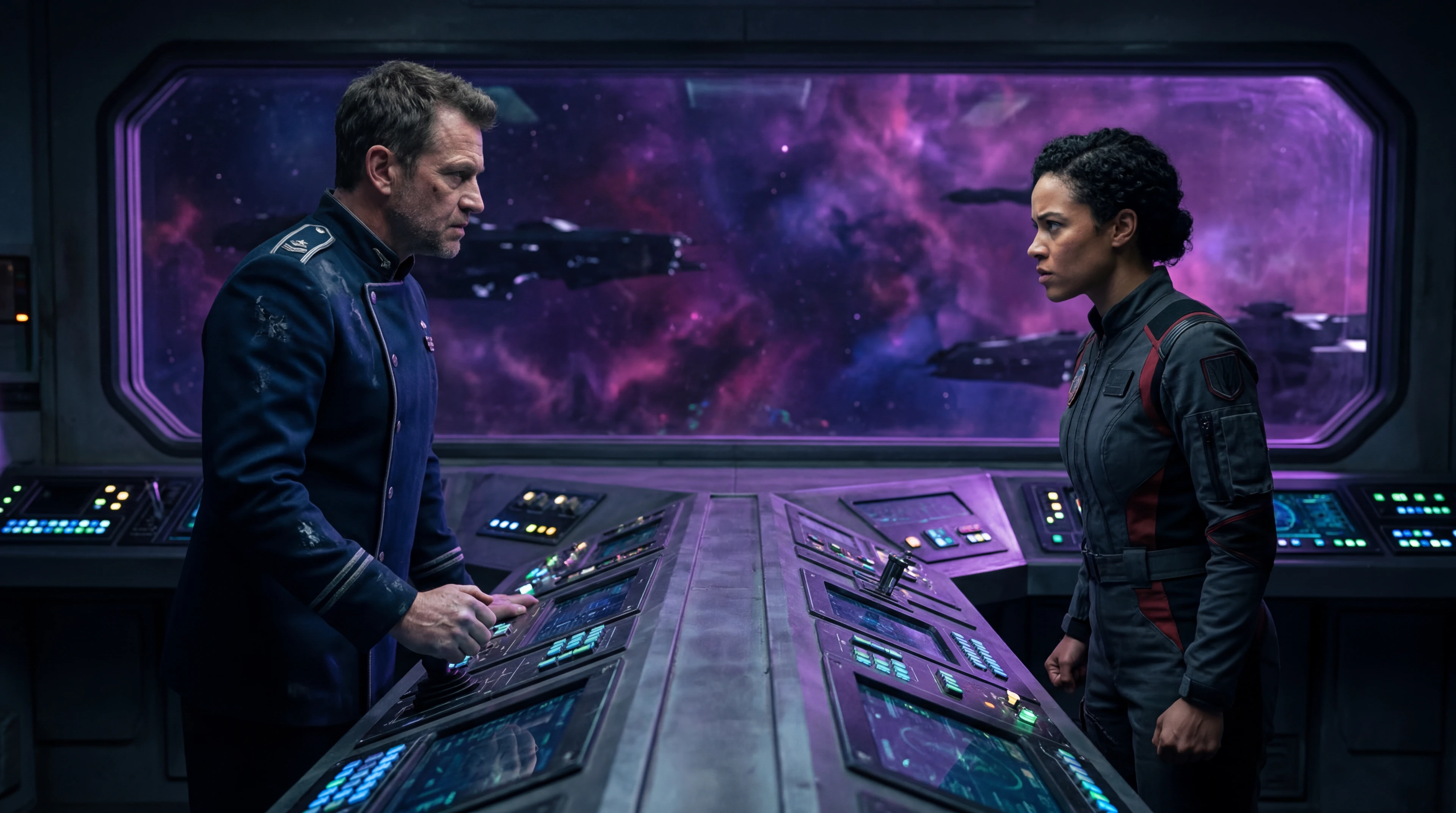
Kira and Thane across the bridge console, holding a conversation neither of them wants an observer to hear.
Commander Voss arrived at Waypoint Four at 0930 the following morning, aboard a Dominion liaison shuttle that was cleaner and newer than anything on the Meridian. Thane met him at the airlock.
“Aldric.” Voss stepped through with the ease of a man who'd walked through a thousand airlocks and considered each one a threshold to be owned. Average height, compact build, silver gray hair cropped close. His Dominion uniform was immaculate, every insignia polished, every crease a declaration. He walked with a slight limp from a war injury he'd never had fully repaired. “The ship looks… adequate.”
“She's functional.”
“She was beautiful, once. Before they pulled her teeth.” Voss surveyed the corridor with pale blue eyes that missed nothing and forgave less. “I remember the Meridian at Kael-7. Finest ship in the Third Fleet. You ran her well, son.”
“That was a different mission.”
“Was it?” Voss smiled. The smile was warm on the surface, instructive underneath. “Walk me through the operation. I want to see what they've done to my fleet's flagship.”
They walked the ship. Voss asked questions about every modification. The sealed gun ports, welded shut with plates that still showed grinding marks from the conversion crew. The torpedo bay on Deck Three, emptied and refit as a cargo hold that smelled of packing material and disuse.
The converted weapons locker now serving as Coalition crew quarters, which Voss examined with an expression Thane recognized from inspection tours during the war: disapproval organized into categories. The potted fern on the targeting array. He said nothing about the fern, but his silence was eloquent.
The Skeleton Remembers
“They've preserved the structural integrity, at least,” Voss said, running his hand along a corridor support strut. “Bones of a warship. You can strip the weapons and seal the ports and put plants on the consoles, but the skeleton remembers what it was built for.”
Thane heard the metaphor. He was meant to.
In the mess hall, they passed the Coalition crew at their corner table. Vasic looked up. Her eyes moved from Thane to Voss and her expression didn't change, but something in her posture shifted. A degree of additional tension. She recognized authority when she saw it.
“The Coalition contingent,” Voss said, as they moved past. “Two of them?”
“Lieutenant Vasic, intelligence liaison. Lieutenant Solari, navigation.”
The Worst Possible Distance
“Vasic,” Voss said the name the way you'd say a data point. “She survived Kael-7.”
“She did.”
“Remarkable pilot, from the records. Ran a recon sweep during the engagement. Two hundred kilometers from the kill zone.” He paused. “Lucky.”
Thane said nothing. He knew the distance because he'd read the engagement report forty times. Two hundred and twelve kilometers. Close enough to hear her squadron die on comms. Far enough to survive. The worst possible distance.
“And you're comfortable with her aboard?” Voss asked.
“The mission requires Coalition representation.”
“Representation, yes. But did it require her specifically? A survivor of the engagement you commanded?” Voss shook his head with practiced concern. “Someone in Coalition Intelligence has a dark sense of humor, Aldric. Or a very specific agenda.”
A Very Specific Agenda
They reached the bridge. Voss stood at the center and looked at the command displays, the disabled weapons console, the navigational arrays still running at full capacity because those, at least, hadn't been gutted.
“You've done well with what they've given you,” Voss said. “Diplomatic service is important work. Even if it doesn't always feel like it.”
“It's the work that matters now.”
“Is it?” Voss turned from the displays. His pale eyes settled on Thane with something that might have been affection or might have been appraisal.
“The ceasefire works because the Dominion is strong enough to enforce it. Not because both sides want peace. One side won. One side lost. The losers will smile and negotiate until they've rebuilt their fleet, and then we'll be back where we started.” He shrugged. “I've seen it before. But you're young. You'll learn.”
He clapped Thane on the shoulder. The contact lasted less than a second. Thane's skin prickled where the fabric had touched. A nothing contact. His body disagreed. He didn't flinch. But the muscles in his shoulder held the tension for ten minutes after Voss had moved on.
Empty Hands
Dinner was communal. Thane ate alone.
This was not a decision. It was a condition. He had eaten alone for the better part of four years, first during the war when the commander's table was separated from the crew's by protocol, and then after the war when the separation persisted out of habit.
Chew, swallow, respond. The mechanics of a meal shared with people who expected conversation, who reached for the salt and their hand passed near his and the proximity registered like a sensor contact.
Not at a separate table. At the same table as Dex and Joss, technically. But Dex was at one end running signal diagnostics on his data pad and Joss was at the other reviewing medical protocols, and Thane sat in the middle with his tray and his silence and the two empty chairs on either side that he'd chosen because they were there.
Voss had taken his dinner to the quarters Thane had assigned him, a converted officer's cabin on Deck Two. Vasic and Solari were at their corner. Sable was in engineering, where she ate most meals, claiming the food tasted better when accompanied by the sound of functional machinery.
Hands With Nothing to Hold
Thane finished his protein block. He stacked his utensils on the tray with the alignment he gave to everything: parallel, centered, ordered. He carried the tray to the recycler and stood there for a moment with his hands empty.
Empty hands were the problem. On a warship, his hands had always held something. A data pad, a comm unit, the railing of the command platform. Tools of control. Purpose. Now the ship ran itself and the crew didn't need commanding and his hands hung at his sides like components removed from a system that no longer required them.
He flexed his left hand. The burn scars pulled.
Footsteps behind him. He turned. Dex was returning his own tray, and in the narrow space beside the recycler, his elbow brushed Thane's forearm. A graze of fabric against fabric, lasting less than a heartbeat.
Thane stepped back. The movement was sharp, involuntary, a full pace of retreat from contact so minor that Dex didn't even register it at first. Then the comms officer looked at him, and his expression shifted from casual to careful.
“Sorry, sir. Tight space.”
“No concern.” Thane's voice was level. His forearm burned where the contact had been, not with pain but with the ghost of sensation, like a comm frequency activating on a channel that had been silent for years.
A Cabin With Nothing Personal In It
He left the mess hall. Walked to his quarters. Closed the door.
His quarters were the commander's cabin, designed for an officer of his rank, which meant they were the largest personal space on the ship and still felt like a cell.
He'd brought nothing personal. No photographs, no keepsakes, no evidence that a human lived here rather than a function. A uniform hung on the back of the door. A data pad sat on the desk, displaying tomorrow's courier schedule. The bunk was made with military corners.
He sat on the edge of the bunk and looked at his hands. The scarred left. The unmarked right. He'd given the firing order at Kael-7 with both of them, fingers on the command console, three words spoken into a silence that would never be silent again.
Weapons free. Execute.
Forty three people.
Forty Three Names
He knew the number. He'd pulled it from the engagement records the day after the battle, when the ceasefire was announced and the celebrations began and he'd locked himself in his quarters to count the cost of victory. Forty three Coalition personnel, including seventeen civilian escort crew. Pilots, mechanics, medical staff. People whose names he'd memorized because he owed them that much, even if he could never pay the debt.
The intelligence report had said military targets. The tactical analysis had been clean. Three words. The war ended.
He pressed his scarred hand against the cool wall of his quarters and breathed. In. Out. The same air the Coalition crew breathed. The same ship they slept in. The same silence.
He stayed like that until the lights dimmed to ship night cycle, and then he lay down in the dark and didn't sleep.
A Tactical Necessity
At 0600, Thane was back on the bridge. Running diagnostics. Reviewing the courier schedule. Occupying his hands.
Voss appeared at 0630, coffee in hand, uniform pristine. He settled into the observer's seat beside the command platform and watched Thane work with the patient attention of a teacher monitoring an exam.
“I reviewed the crew manifest last night,” Voss said. “Interesting mix. Maro's a good officer. Wastes his talent on charm, but the signals work is solid. Kade is competent. Solari, by Coalition standards, is adequate.”
“And Vasic?”
Voss sipped his coffee. “Vasic is the most decorated combat pilot the Coalition produced during the war. She flew thirty seven sorties and came back from all of them. Her squadron trusted her completely.” He paused. “And then she wasn't there for the one that mattered.”
The bridge was silent. The environmental system hummed. The navigational beacons pulsed their steady red and blue beyond the viewport.
“The Coalition dead at Kael-7 were a tactical necessity,” Voss said. “Regrettable, but necessary. The intelligence was solid. The orders were correct. The war ended because of what happened at Kael-7, Aldric. Don't let the proximity of one survivor make you second guess decisions that saved millions.”
Thane looked at the navigational display. The Transit Corridor stretched ahead, a path between two powers that had spent a decade trying to destroy each other and were now connected by beacons and courier ships and the fragile fiction that cooperation was possible.
He said nothing.
Voss mentioned the Coalition dead like they were a footnote in a report. A data point. A line item in the cost benefit analysis of victory. And Thane went silent, because the silence was louder than anything he could say, and because the truth was that he'd spent five years carrying those forty three names like stones in his chest, and hearing someone dismiss them as a tactical necessity made the stones heavier, not lighter.
He didn't know how to explain that to Marcus Voss.
He wasn't sure he knew how to explain it to himself.
The navigational display pulsed. Waypoint Five approaching in fourteen hours. Another packet exchange. Another day of the postal service pretending to be a peace process. Below deck, the Meridian's reactor hummed its deep constant note, the sound of a ship that had been built to kill and was learning, badly and slowly, to carry something other than weapons.
Thane listened to the hum. It sounded like a question he didn't have the answer to.
He turned back to his diagnostics and kept his hands busy.
He carries forty three names. She carries orders to add one more.
Then a relay station explodes, and the real war starts.
Back in her POV.
Watch trust fracture and rebuild in real time.
Or keep reading Chapter 3 below
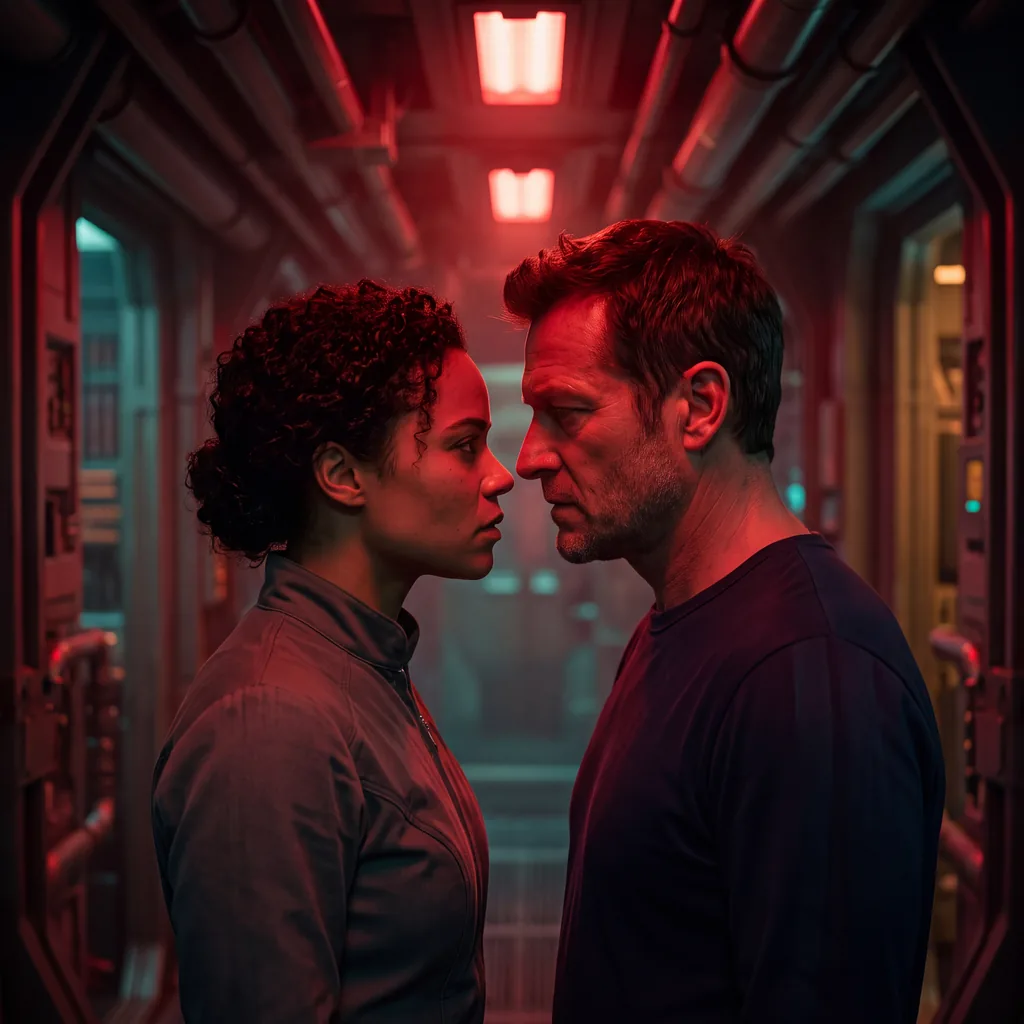
Twenty centimetres apart under the emergency lights, and neither of them stepping back.
Chapter 3: Forty Three
Kira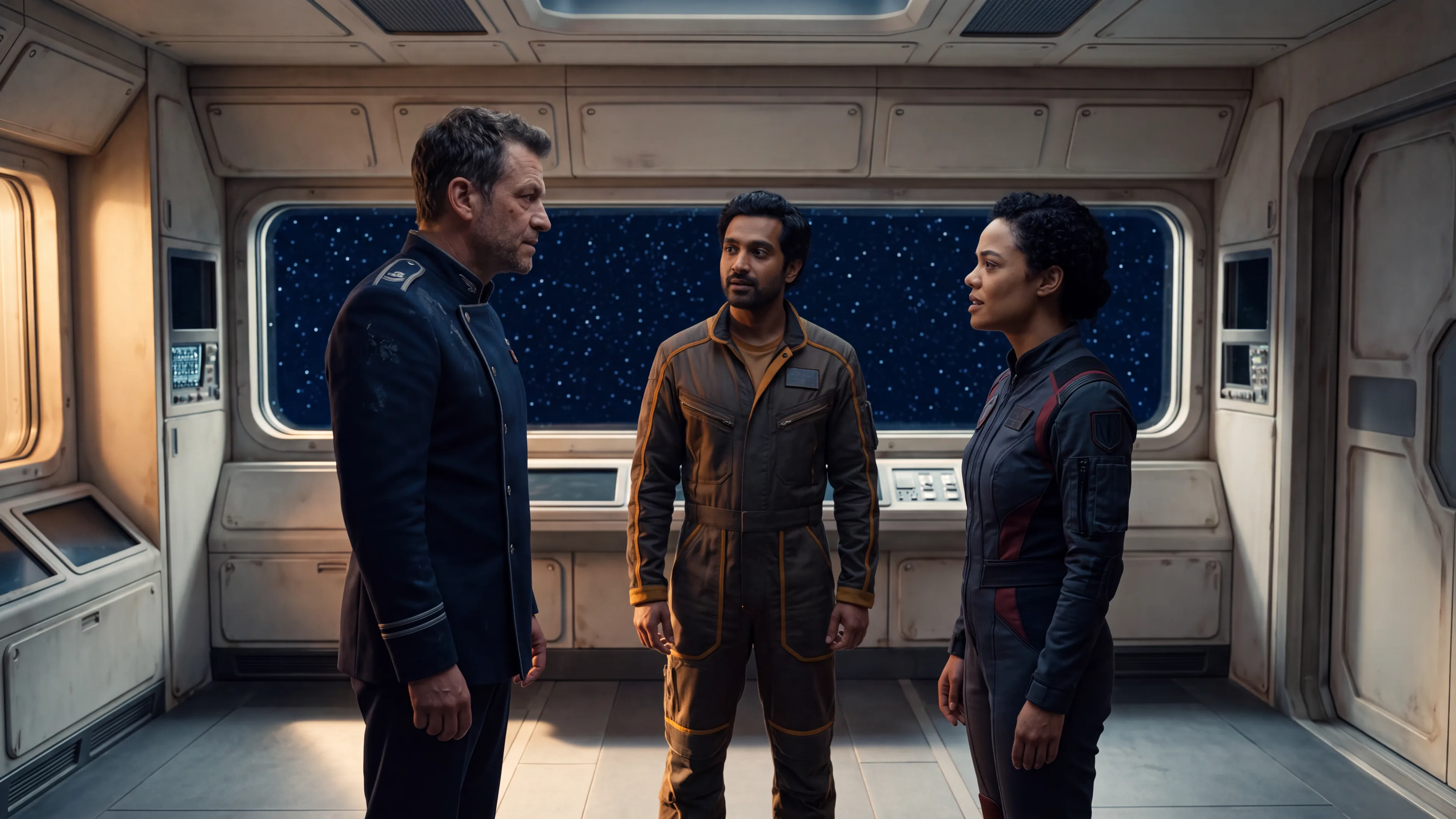
The relay station detonated before they finished the morning briefing.
One moment Aldric was outlining the day's courier schedule, his voice steady as a navigational beacon. The next, every alarm on the Meridian screamed to life.
The ship shuddered. Not a physical impact, not at this range, but a sympathetic vibration through the hull that Kira felt in her sternum. The Meridian's sensor arrays were picking up the shockwave from forty thousand klicks and translating it into data, and the data made the ship tremble.
Red light flooded Conference Room A, painting the walls and the faces around the table in arterial red. The holo table display flickered, stuttered, the holographic projection breaking into static snow before reassembling itself with the urgency of emergency protocols overriding standard display.
The courier route vanished. An emergency feed replaced it: Transit Corridor Relay Station Seven, erupting into a cloud of metal and expanding gas off their port bow.
The station had been there yesterday. Kira had routed a comm signal through it eight hours ago. Now it was debris, expanding into the void, and the display rendered it in clean geometry that made catastrophe look like mathematics.
The Smell Changed
The smell changed. Kira's nose registered it before her conscious mind caught up. Ozone.
The Meridian's electrical systems had responded to the sensor overload with a burst of static discharge through the hull plating, and the air in Conference Room A crackled with it. The taste sat on the back of her tongue, sharp and chemical, the taste of something burning that shouldn't be.
Kira was on her feet before the alarms finished their first cycle. Her chair slid back and hit the wall. Her hands balled into fists at her sides. Reaching for a flight stick that wasn't there. “That's a tactical detonation. Not mechanical failure.”
Aldric had moved to the comm panel on the wall, fingers already keying the emergency channel. His face was composed, his voice clipped. “Dex, bridge. Full sensor sweep. I want debris analysis in ninety seconds.”
“Moving,” Dex's voice crackled through the intercom. The sound of running footsteps underneath.
Coalition or Dominion Signature
Maren was at the holo table, pulling up the relay station's last transmission log. Her hands moved with the efficiency of someone who'd navigated through combat zones and understood that data decayed faster than wreckage. “Station Seven was broadcasting standard corridor telemetry until 0817. Signal terminated with a single burst of interference consistent with an energy weapon discharge.”
“Coalition or Dominion signature?” Aldric asked.
Maren's jaw tightened. She expanded the interference pattern on the display. The waveform was distinctive: a sharp spike followed by a cascading decay pattern that Kira recognized before Maren spoke. Every pilot in the Coalition fleet had trained against that signature.
“Coalition plasma torpedo.” The three words landed on the briefing table like a detonation of their own. Maren's voice was steady but her hands had stopped moving. “Mark IV variant. Standard issue for Coalition assault corvettes.”
Her Faction's Fingerprint
The room went quiet. Red emergency lighting painted everyone in shades of blood. The holo table's blue glow fought against the red, creating a twilight that turned familiar faces into something harder to read.
Kira could hear the ventilation system cycling, the distant thrum of the engines, and the absence of the relay station's carrier signal. A frequency she hadn't consciously noticed until it was gone, leaving a hole in the ambient sound that felt like a held breath.
Kira stared at the waveform. Mark IV plasma torpedo. Coalition weapons signature. Her faction's fingerprint on a destroyed relay station in neutral territory during an active ceasefire.
“That's not possible,” she said.
Voss, who had been silent in his observer's chair, leaned forward. “It appears quite possible, Lieutenant. The evidence is on the screen.”
“Evidence can be manufactured.”
“It can also be accurate.”
Kira looked at Aldric. He was watching the debris pattern on the display with an expression she was learning to read: the stillness of a man processing information before committing to a response. His gray eyes moved across the data. His left hand gripped the edge of the comm panel.
“We don't reach conclusions before we reach evidence,” he said. “Dex, I need that debris analysis. Sable, report to the bridge. Maren, pull all corridor traffic logs for the last twelve hours. Vasic, with me.”
It wasn't a request. She followed him to the bridge.
Textbook Detonation
The bridge was alive for the first time since Kira had boarded. Every console hummed with active data feeds, casting amber and blue light across the dark walls.
The main viewport showed nothing but stars and the faint shimmer of the debris field at extreme visual range, a glitter of metal catching light from the nearest sun. Dex had the sensor arrays at full power, his fingers dancing across the console with an efficiency that stripped away his usual irreverence.
Navigation screens displayed the debris field in real time, fragments of Relay Station Seven tumbling through the corridor in a slowly expanding sphere. Each fragment was tagged with a sensor ID and a mass estimate, and the pattern they formed told a story if you knew how to read it.
Kira knew how to read it. She'd spent two years analyzing weapons impacts during the war. The debris spread was asymmetric, concentrated on the station's port side, which meant the torpedo had come from the starboard approach corridor. Someone had fired from a position that put the station between themselves and the Meridian's sensor arrays. Professional.
Sable arrived at a run, tool belt jangling, grease on her cheek and a smear of coolant on her forearm. She took one look at the sensor data and sat down at the engineering station without a word. Her fingers pulled up the station's pre destruction power grid schematic, and Kira watched her overlay it against the debris pattern with the practiced efficiency of someone who understood that machines told the truth better than people.
Exactly Textbook
“Debris analysis is in,” Dex said. “Hull fragmentation pattern is consistent with a single point external detonation. The charge hit the station's main comm array and propagated through the power core.”
“Confirm the weapons signature,” Aldric said.
“Confirmed. Coalition Mark IV plasma torpedo. Detonation yield matches spec.” Dex hesitated. “Commander, the yield is textbook. Exactly textbook. Nominal charge, nominal dispersion pattern. No variance.”
Kira caught it. “Real torpedoes have variance. Manufacturing tolerances, environmental factors, target composition. A textbook detonation is a simulation detonation.”
“Or someone loaded exact spec charges to avoid identification through variance analysis,” Voss said from the observer's station. “Which is what an intelligence operation would do.”
Kira turned to face him. Voss sat with his hands folded, his expression one of measured concern. The limp he'd walked in with was invisible when he sat. Only the pale blue eyes moved, tracking the conversation like a predator tracking motion.
“You're suggesting Coalition Intelligence destroyed their own relay station?” she said.
“I'm suggesting the evidence points in a direction, Lieutenant. That's all.”
“The evidence points to a weapons signature that any competent operator could replicate with access to Coalition ordnance specifications. Those specs leaked four times during the war.”
“That's also true.” Voss inclined his head. “Which is why we need a thorough investigation.”
Three Vessels in Twelve Hours
Aldric cut through. “Both positions are noted. We don't speculate. We investigate.” He pulled up the corridor traffic logs on the main display. “Maren, what do we have?”
Maren's voice came through from Conference Room A, where she'd remained with the holo table. “Three vessels transited the corridor within weapons range of Station Seven in the last twelve hours. One Coalition freighter, registered and on schedule. One Dominion patrol corvette on standard picket duty. And one unregistered vessel that passed through at 0400 with transponder dark.”
“An unregistered vessel in a ceasefire corridor,” Kira said. “That's a treaty violation.”
“It's also the most likely delivery vehicle for the torpedo,” Aldric said. “Dex, can you track the unregistered vessel?”
“Already on it, sir. The sensor buoys along the corridor recorded a mass shadow consistent with a small craft, maybe a courier class ship. It entered from the Dominion side of the corridor and exited toward the neutral zone. I can give you an approximate heading but no ID.”
“Do it.”
Kira watched Aldric work. He stood at the center of the bridge with his hands behind his back, turning his head between displays like a conductor following multiple instruments. His questions were precise. His tone carried the authority of a man who'd commanded a warship in combat and brought that same discipline to an investigation. He didn't raise his voice. He didn't need to.
She hated that she respected it.
The Ceasefire's Eyes
The initial investigation took four hours. By the time they assembled in Conference Room A for a debrief, the facts were these:
Transit Corridor Relay Station Seven had been destroyed by a weapon bearing Coalition signatures. The station had provided real time communication relay between Coalition and Dominion diplomatic channels. Without it, a forty hour gap now existed in the corridor's communication coverage. During that gap, neither faction could confirm the other's movements.
Someone had punched a hole in the ceasefire's eyes.
The room was tense in a new way. Not the careful hostility of the first briefing. This was sharp edged, the tension of people who needed to trust each other and had just been given a reason not to.
The emergency lighting had been canceled but the residual red cast lingered in the corners of the room like a stain. The air tasted of recycled ozone. Someone had made coffee, and the thermos sat untouched in the center of the table, a gesture of normalcy that no one needed.
The Same Flat Hands
Maren sat rigid, her data pad in front of her, her face a mask of professional composure that Kira recognized as the expression Coalition officers wore when they were furious and outnumbered.
Her hands were flat on the table, and Kira noticed they were positioned exactly as her own had been during the first briefing. Mirror images. Two Coalition women on an enemy ship, trained in the same academy, holding the same posture because the same instructors had taught them that flat hands on a table said I am not reaching for a weapon.
Dex had lost his easy posture. Joss watched everyone with the quiet alertness of a medic assessing a room full of patients who didn't know they were bleeding. Sable cleaned her nails with her stylus, which Kira was beginning to understand meant she was listening harder than anyone.
A Report, or the Truth
Voss spoke first. “The evidence is preliminary but concerning. A Coalition weapons signature on a destroyed relay station is going to trigger a response from Dominion High Command.”
“If it reaches Dominion High Command before the investigation concludes,” Aldric said.
Voss looked at him. A long look. “You're suggesting we delay the report?”
“I'm suggesting we complete the investigation before we file one. A premature report with incomplete data could escalate a situation that might have a straightforward explanation.”
“Or it could allow a guilty party to destroy evidence of a ceasefire violation.” Voss spread his hands. The gesture was reasonable, diplomatic, and Kira distrusted it completely. “I understand your caution, Aldric. But we have obligations.”
“We have an obligation to the truth. The truth takes time.”
Kira watched the exchange. Two Dominion officers, one senior, one junior, disagreeing in the measured language of men who'd spent careers in hierarchies where disagreement was a form of combat. Voss was pushing for a report. Aldric was pushing for patience. Both positions were defensible. Neither was neutral.
Too Clean to Be Real
“The torpedo signature is clean,” she said. Both men looked at her. “Too clean. I've been in Coalition ordnance briefings for six years. Our torpedoes have manufacturing variance of point three to point seven percent across every measurable parameter. This detonation had zero variance. That's not a real torpedo. It's a copy.”
“Or it's a torpedo from a carefully maintained arsenal,” Voss said. “Some units maintain tighter tolerances.”
“Name one.”
Voss smiled. “I'm not a Coalition ordnance expert, Lieutenant. Are you claiming your faction's weapons aren't capable of this?”
The room shifted. Kira felt it the way you feel a change in atmospheric pressure before a storm. The question wasn't technical. It was political. Voss was asking her to defend the Coalition, which meant he was framing the Coalition as something that needed defending.
“I'm claiming the evidence isn't conclusive. And I'm not going to let a preliminary weapons signature override due process.”
“No one is suggesting that.”
“Good.” She turned to Aldric. “Commander. I want access to the full debris analysis. The raw sensor data. And the traffic logs for the Dominion side of the corridor.”
A beat of silence. Aldric's gray eyes held hers. He was weighing the request. She could see the calculation: grant a Coalition officer access to Dominion corridor data and risk an intelligence leak, or deny it and confirm that this investigation would be Dominion controlled from the start.
“Granted,” he said. “All data shared equally between both factions. This is a joint investigation.”
Voss said nothing. But his expression, for a fraction of a second, tightened.
Two Hundred and Twelve Kilometers
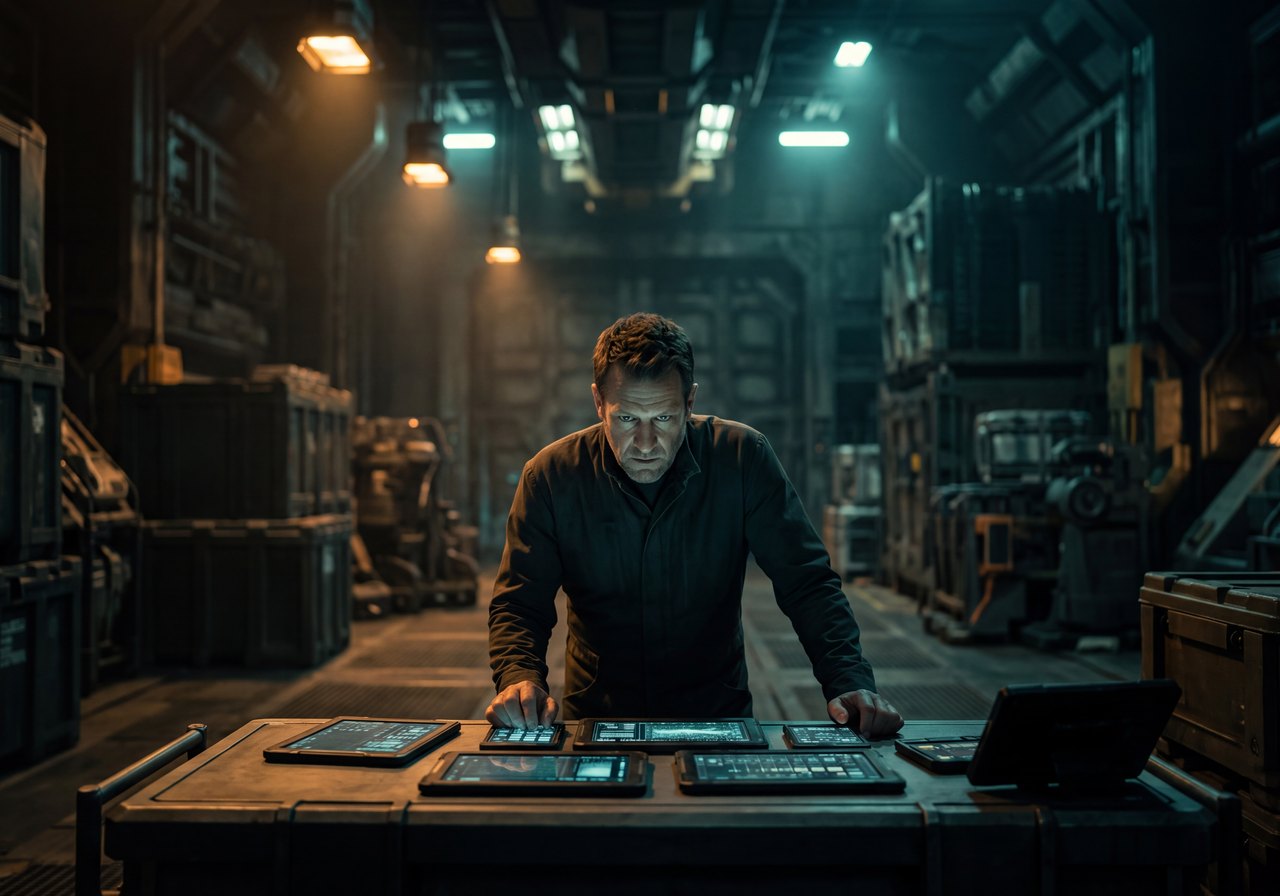
Thane alone in the cargo bay, working the sensor logs one data point at a time.
Kira worked alone in the makeshift analysis room Sable had set up in the port side cargo bay. The bay was cavernous, designed to hold ordnance crates for a full combat deployment, now empty except for the workbench, two chairs, and a portable display unit that Sable had rigged to pull sensor data from the bridge.
The overhead lights were industrial, bright enough to read by but cold, and the deck plates under her boots vibrated with a different frequency here, deeper, closer to the reactor. Data pads covered the work bench. Sensor readouts, debris projections, corridor traffic patterns.
She'd been at it for three hours, her coffee cold, her neck stiff, and the pattern was becoming clearer with every data point.
The attack was professional. Precise. Designed to maximize communications disruption while minimizing evidence of the attacker.
Whoever did this knew the relay station's architecture, its power routing, and exactly where to strike to trigger a cascade failure. They'd targeted the junction between the comm array and the power core, a classified structural vulnerability that both factions shared because both factions built their relay stations from the same pre war design specifications.
That required intelligence. Detailed, current intelligence on a station that both factions used. Not the kind of intelligence you got from leaked specs. The kind you got from operational access.
She pushed back from the bench and pressed her palms against her eyes. In the dark behind her eyelids, another explosion played. Not the relay station. Kael-7.
Forty Three Signals
The memory came in fragments, the way it always did. Not a narrative. A sensory assault.
The flash of detonation across her cockpit canopy, turning the stars white. The vibration through her cockpit chair as the shockwave reached her at the edge of the engagement zone, strong enough to trip her proximity alarms, weak enough that she survived. The taste of blood where she'd bitten the inside of her cheek.
The sound of forty three comm channels going to static in sequence, one after another after another, like a choir going silent voice by voice.
Talon Two. Talon Three. Talon Four through Nine in a cluster, gone together, which meant they'd been in formation when the strike hit. Talon Ten through Fifteen, the escort wing, dropping in pairs.
The civilian transports on the shared frequency, their comms operators asking for updates that no one could give because the people who should have been answering were already dead.
And Bishop. Talon Lead Two. Her wingman for four years and six months. The one who always checked in with “still here” after every engagement, the two words that meant the formation was intact, that the people who mattered were alive. His final “still h—” cut to white noise.
She'd been two hundred and twelve kilometers away. Running a recon sweep at the edge of the engagement zone, close enough to receive comms, too far to intervene.
Her shuttle had the range to get there in eighteen minutes at maximum burn. The engagement lasted ninety seconds.
She'd listened to her squadron die over the span of ninety seconds and she'd been able to do nothing except count the signals as they dropped. One through forty three. She remembered the count because she always remembered the count.
The relay station explosion today had smelled the same. Ozone and burning metal. Same smell. Different dead.
Footsteps in the Cargo Bay
Footsteps behind her. She opened her eyes and wiped her face with the back of her hand. When she turned, Aldric stood in the doorway of the cargo bay with a data pad in his hand.
“The unregistered vessel's heading tracks toward a disused mining facility in the neutral zone,” he said. “Dex pulled it from the sensor buoys.”
“Show me.”
He walked to the bench and placed his data pad beside hers. Their hands moved over the same data set, pulling up trajectory maps and cross referencing sensor timestamps. The heading intersected with a cluster of derelict mining platforms abandoned before the war. Plenty of places to hide a small ship. Plenty of places to stage an operation.
“I'll want to check the platform's power signatures,” she said. “If someone used it as a staging base, the reactor would show residual activity.”
“Agreed. I can pull the baseline readings from the pre ceasefire survey records.”
Twenty Centimeters Apart
They worked through the cross reference in silence. He reached for the same data pad she was reaching for, and their fingers stopped a centimeter apart. He pulled back. She pulled back. Neither of them acknowledged it.
But the air in the twenty centimeters between her shoulder and his felt charged, dense, like the static discharge that still sat on the ship's hull plating. Her body had registered his proximity as a threat, which was correct, but the threat assessment was blurred by something else.
An awareness of the way he held himself still when he was thinking. The careful way he placed his data pad on the bench, aligned with the edge, precise as a weapon laid down.
She was twenty centimeters from the man who had ordered her squadron killed. Her hand went to her jacket pocket, automatic. The device was there. The orders were there. She left her hand where it was.
He nodded. They stood side by side at the bench, close enough that she could smell the Meridian's recycled air on his uniform and something underneath it, soap maybe, something plain and unremarkable.
“Lieutenant Vasic.”
She looked at him. His face was composed, as always. But something in his jaw had shifted. A tightness. He was about to say something that cost him.
“The weapons signature. The zero variance.” He paused. “You're right. It's too clean. Real ordnance doesn't detonate at exact specification.”
“I know.”
“I wanted you to know that I know.”
She held his gaze. The fluorescent lights of the cargo bay hummed above them. His gray eyes were steady, careful, the eyes of a man offering an ally's acknowledgment across enemy lines.
“Forty three people, Aldric.”
The words came out before she decided to speak them. Not a non sequitur. A test. A weapon. She watched his face for the impact.
He took it without flinching. His expression didn't change. But his breathing did. A fractional pause between inhale and exhale, the kind of interruption you'd miss if you weren't standing twenty centimeters away with five years of rage tuning your senses to every microexpression on his face.
“Yes,” he said.
One word. No defense. No context. No explanation. Just acknowledgment. He didn't say it was war or the intelligence was solid or I had no choice. He said yes.
She didn't know what to do with that.
She turned back to the data. “Let's find who destroyed that relay station. Then we can argue about everything else.”
Mirror Images
The second attack came eight hours later.
Dex picked it up on the long range arrays at 0200 ship time, a distress signal from a Dominion supply convoy in the eastern corridor. By the time Kira reached the bridge, the damage report was already scrolling across the main display. Three supply vessels disabled by precision weapons fire. Cargo pods breached. No casualties, but the supplies were lost.
The weapons signature on the supply convoy was Dominion.
Kira stood at the bridge railing and read the analysis twice. The supply convoy had been hit by Dominion signature weapons. The relay station had been hit by Coalition signature weapons. Someone was hitting both sides, using each faction's weapons against the other.
This wasn't sabotage by one faction against the other. This was sabotage designed to make both factions believe the other had struck first. A provocation engine running on mirror images.
“Both sides,” she said.
Aldric stood at the command platform, his face lit by the amber glow of the sensor displays. He looked at the data with the focus of a man who'd spent his career reading tactical patterns and recognized this one for what it was.
“Both sides,” he said. “Someone wants a war.”
The bridge was silent except for the steady pulse of the navigational beacons and the soft hiss of recycled air. Dex stared at his console. Maren had come to the bridge in her sleepwear, data pad in hand, her silver streaked hair uncovered for the first time. Even Sable had emerged from engineering, standing in the doorway with her arms crossed and her reading glasses pushed up on her forehead.
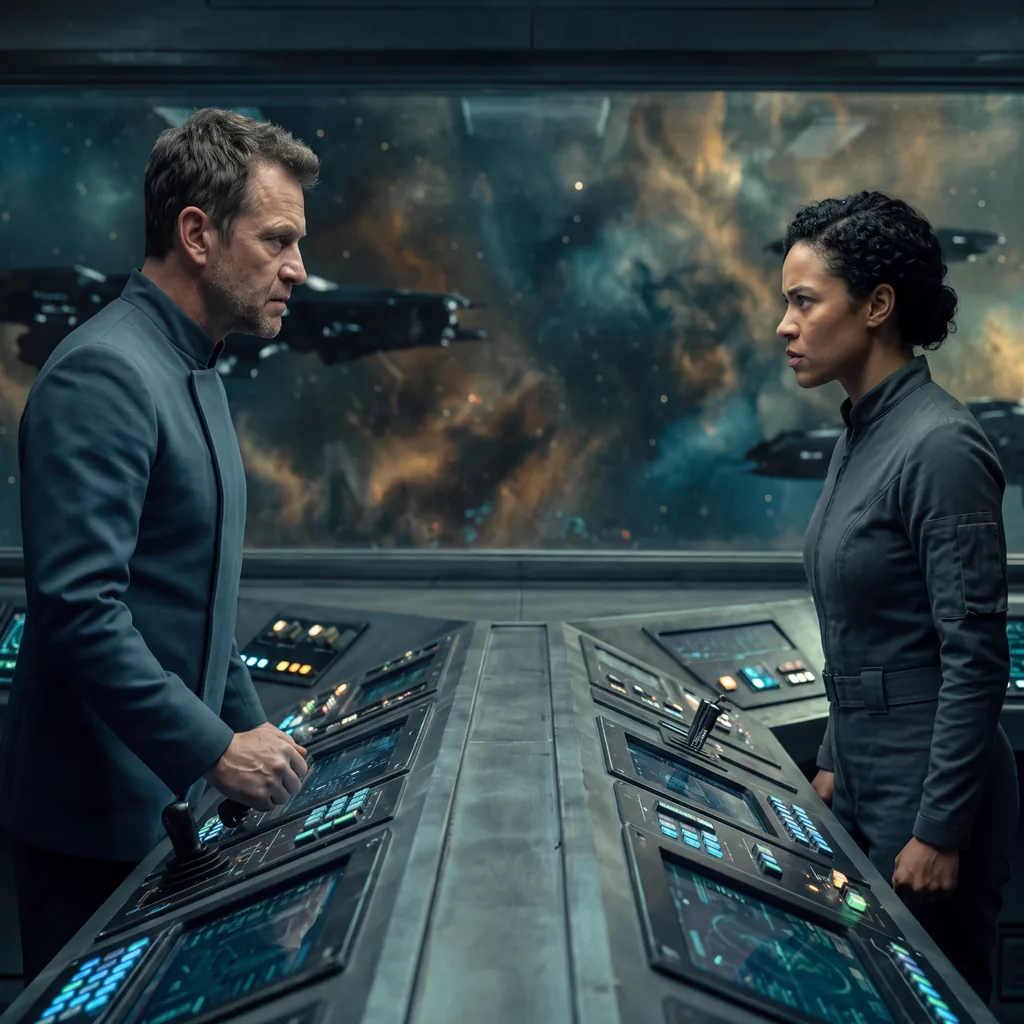
The enemy wasn't across the table.
Kira looked at the data. Two attacks. Two faction signatures. Both too clean. Both precisely targeted to maximize disruption and minimize casualties. Designed not to kill, but to provoke. To fracture the ceasefire from both sides simultaneously.
Her pilot's mind ran the scenario. Someone had planned this with the precision of a mission briefing. Target selection, timing, weapons specifications, exfiltration routes. This wasn't rage or opportunism. This was methodical.
Someone who understood military operations from the inside, who knew how both factions' intelligence services analyzed weapons signatures, who knew that the first instinct of every officer in the room would be to suspect the other side.
She looked across the bridge at Aldric. He was looking at her.
In the amber light of the sensor displays, his face was unreadable, but his eyes had lost the careful neutrality he'd maintained since she'd boarded. What she saw instead was something closer to recognition. He was running the same calculation she was. They had reached the same conclusion at the same moment, standing on opposite sides of a bridge that used to be his warship, and the conclusion was this:
The enemy wasn't across the table. The enemy was out there, and whoever they were, they wanted everyone in this room to tear each other apart.
Someone with access to both factions' weapons specifications, communications protocols, and operational schedules was running a campaign to restart the war. And they were doing it from inside the system.
End of free sample
19 Chapters Left. She Hasn't Decided Yet.
Someone is manufacturing a war from the inside.
The ceasefire is cracking.
And the assassin sent to kill Thane Aldric?
She's becoming the only person he trusts.
Chapter 4 opens at 0400.
Thane is alone on the bridge.
He hasn't slept since she said “forty three.”
They save each other's lives in Chapter 8.
By Chapter 14, every rule they swore to keep is broken.
And forty three? You won't forget that number.
Not after Chapter 22.
22 chapters · Dual point of view · Enemies to lovers · Guaranteed happily ever after
You've read the opening. Drag through the climb still ahead.
Chapter 1: two officers from opposing factions, assigned to the same warship.
- Enemies to lovers
- Slow burn, closed door
- Dual point of view
- Human only, no aliens
- Standalone happy ending
- No cliffhanger
- EPUB and PDF, no copy protection
- Yours to keep
- Direct from the author
- Yours to keep
- Read on any device
Price in USD. Australian, EU and UK buyers see the exact GST or VAT inclusive price at checkout.
EPUB and PDF, yours to keep.
Direct from the author at spacemance.com.
Still readable on your Kindle: send the EPUB with Amazon's free Send to Kindle tool.